Grasslands, Meadows And Prairies:There Is A Lot Of Value To Grass In The Natural World
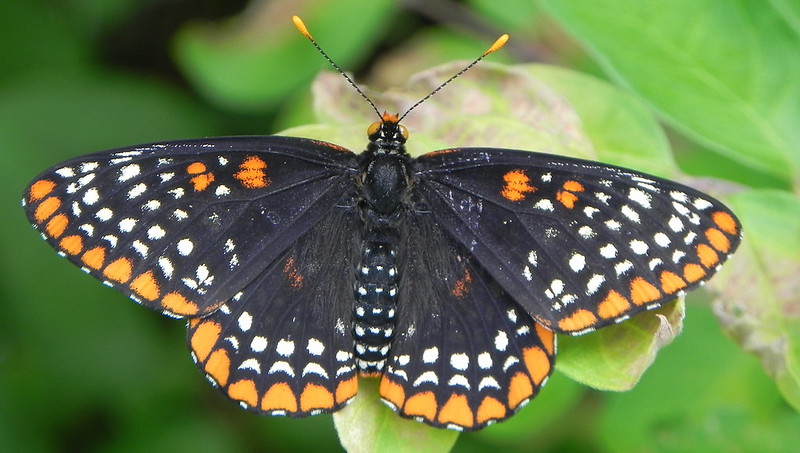
A number of insects, like Baltimore Checkerspot butterflies, rely on fields for flowers and food.
In early spring, grass is one of the first things to turn green and bring back that feeling of new life and growth. Eventually dandelions, clovers, henbit, speedwell, and other plants will follow, bringing back color to the natural world and encouraging animals to seek them out as food sources.
When I say the word ‘grass’, it’s likely that a mowed lawn or park comes to mind. But what if you think a little bigger, taller, and wilder? Grasslands are evocative in both the summer and fall. Summer brings out an abundance of colorful flowers, tall plants, and the birds and insects that utilize them. Autumn grasslands, at least around here, are oceans of golds and purples, as goldenrod and other late summer flowers bloom as long as they can before their world freezes and the plants die back to stems and seeds.
Grasslands come in unexpectedly wide varieties, and while the terms field, meadow, prairie, and savannah might get used interchangeably, there are distinct differences between some of them. At the core, a grassland is any area where the vegetation is primarily composed of grasses and non-woody plants. The details of soil, plant composition, the presence of trees, and the amount of water available are all what determine exactly what kind of grassland is present.
Typically, meadows are what we call the grassy areas in the northeastern US. Meadows are not necessarily a distinct type of grassland, but they are often transitional. They came to be either from a natural reason like a wildfire or a human-created space like an abandoned farm field. Over time, shrubs will start growing, followed by trees and eventually many meadows turn back into forests. At Audubon, the staff mows sections of fields, rotating through different areas year to year, to maintain certain areas as meadows due to their ecological importance. This is a practice used at many nature centers, parks, and other places throughout the country. The practice of maintaining and creating meadows has also been accomplished by prescribing burns, both in the modern day and historically by native groups.
Prairies are a more permanent type of grassland that exist without intervention. These are prevalent throughout the midwestern region of the US. Areas with a perpetual grassland exist due to some climate-related reason that prevents woody plants from growing, whether it is because those areas experience longer periods of drought, are at a high altitude, or are in the presence of salty coastal air and water.
Savannahs and prairies are similar; the difference lies in the tree cover. Savannahs have less than 30% tree covers, while prairies have less than 10% tree cover. The deeper you go, the more specific the categories can get. Even the types of grasses, sedges, rushes, and non-woody plants vary from area to area.
Whatever the name, each type of grassland supports a diverse and important ecosystem. Find an established grassland with an abundance of native plants and you will find butterflies, dragonflies, voles, rabbits, frogs, birds, and many other species thriving.
Walking through a meadow in the summer should be the equivalent of entering a busy community. Pollinators, like bees and hummingbirds, rely on the native flower’s nectar and flowers, in turn, rely on the pollinators to reproduce. On many of the goldenrods, small flies and wasps lay their eggs in the stems, creating a small, bulbous section called a gall.
All of these insects and invertebrates are a food source for a myriad of birds. Meadowlarks, warblers, and bluebirds are all hunting for caterpillars, flying insects, and other invertebrates that grow and reproduce there. Really any bird that eats bugs is going to rely on fields as a vital food source. Take a moment to observe and you might see a tree swallow or a kestrel swoop across to catch a flying insect.
You might also hear a rustle and see the grass move in time to the footsteps of another animal. Underneath the cover of the grass, voles and shrews are running around looking for food and shelter. Rabbits and groundhogs use the tall grass for cover. A hawk could swoop down to catch one of their insectivorous prey animals like the shrew or other birds. Deer are nonchalantly munching on favorite leaves and flowers as they make a path through the middle.
In addition to directly supporting wildlife, the tall grasses and flowers also have an equally impressive root system below. These deep roots help prevent erosion and filter out pollution, which is beneficial for the habitat and for humans.
Grassland habitats also encompass human-dominated and agricultural areas. Fields where we graze cows and grow corn or soy fit the definition. In altered pastures, invasive species tend to gain footholds quickly and take over. These plants do not often have the same root structure, and fewer animals can use them as a food source, damaging the grassland community as a whole.
Even in a mowed area, the types of grasses and plants vary depending on how it is managed. If you have any say in a yard or other green space, consider creating your own mini-meadow. Or even just letting the dandelions and other small flowers grow. Those small plants can still be important food sources. The mowed, uniform, bright green grass might be aesthetically pleasing to certain human eyes, but that’s about the only animal that would agree. With minimal food sources and hiding spaces, few animals find those areas as a suitable habitat.
Over time, most of our grassland habitat has been taken over by agriculture and yards, replacing the native grasslands that support a wide diversity of both plant life and different species of animals. Keeping our meadows, prairies, and savannahs around benefit all types of creatures, from the smallest insect to the largest bison, to the humans watching a butterfly land on a flower as tall as they are.
Audubon Community Nature Center builds and nurtures connections between people and nature. ACNC is located just east of Route 62 between Warren and Jamestown. The trails are open from dawn to dusk and birds of prey can be viewed anytime the trails are open. The Nature Center is open from 10 a.m. until 4:30 p.m. daily except Sunday when it opens at 1 p.m. More information can be found online at auduboncnc.org or by calling 716-569-2345.
Community

BOCES Juniors Drive Change In Automotive Body Repair Program

Pets Of The Week: Two-Tone, Selene – Westfield Stray Cat Rescue

Dwyer Veterans Peer Support Group Gala Is April 18
Washington Middle School Names Honor, Merit Rolls
Washington Middle School officials recently announced the school’s honor and merit rolls for the second trimester ...

The Resource Center Honors Employees