Winter Solstice – The Return Of The Sun
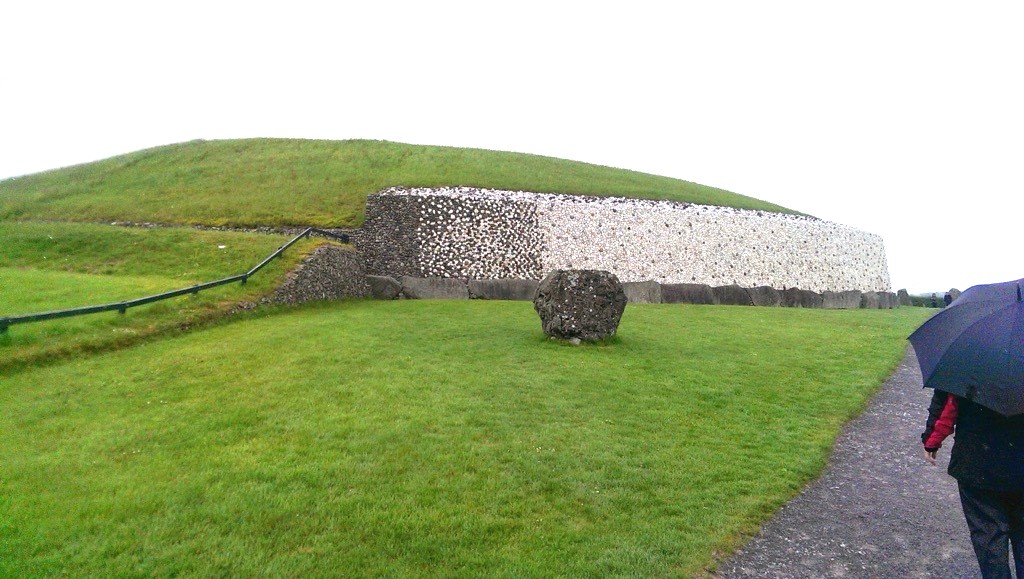
This year’s Winter Solstice will occur on Dec. 21. Many ancient sites, like Newgrange in Ireland, pictured, were built to be aligned with and track the Winter Solstice. Photo by Bethany O’Hagan
The winter solstice is upon us and is happening on December 21st. It’s the moment when the Earth’s tilt makes our hemispheres lean farthest away from the Sun, creating the shortest day and longest night of the entire year. In our Northern Hemisphere, this happens yearly around December 21st or 22nd, while in the Southern Hemisphere it occurs around June 20th or 21st. The solstice has been a vital day of recognition for many early societies that were dependent on agriculture and seasonal cycles. It reassured them that, despite the long night, the sun would return and bring warmth and growth again. Today, with our snowy covered grounds, lake-effect winds, and below freezing temperatures, these traditions continue as reminders of humanity’s deep connection to the rhythms of the amazing Earth we inhabit.
What winter solstice means for our planet Earth is that it is in fact an astronomical event. It occurs when the Sun’s path in the sky reaches its southernmost point (over the Tropic of Capricorn) making the shortest day and longest night of the entire year. The Sun travels its shortest arc across the sky on the winter solstice, giving minimal daylight on an already cold day. It marks the official start of astronomical winter in the Northern Hemisphere. On the solstice, the Earth’s axis is maximally tilted away from the Sun, causing the polar regions to experience extreme effects. Where I am from, up in Alaska, the Arctic has 24 hours of darkness on the solstice, while the Antarctic enjoys 24 hours of daylight. Many traditions see this as a time of rebirth, renewal, and celebration of light returning. Because from this moment on, it is only going to get brighter outside.
Ancient sites like Stonehenge were built to be aligned with and track the solstice, showing just how important these days were to early civilizations. I was even lucky enough to have visited what is thought of as one of the first ever Winter Solstice temples, which is in Ireland. A prehistoric site that was constructed about 5,200 years ago (3,200 B.C) which makes it older than Stonehenge, and the Great Pyramids of Giza. Newgrange, in Boyne Valley, County Meath, Ireland is an ancient temple which is believed to have served not only as a burial site but also as a place of spiritual and astronomical significance. Newgrange was made so that for about 7 minutes on the morning of winter solstice, it illuminates its interior passages by only the winter solstice sun, which sounds like something straight out of an Indian Jones movie. It was so amazing being able to go inside and see the inner chamber which was built to align specifically with the winter solstice sun and thought to mark the beginning of the new year.
Newgrange isn’t the only ancient solstice monuments either. In Mexico, the Mayans have Chichen Itza, which I have also had the pleasure of visiting. Egypt has the Karnak Temple, Peru has Machu Occhu, and the U.S., has Hovenweek Castle built by ancestral Puebloans. Winter Solstice has long been celebrated with festivals such as Yule, Dongzhi, and Inti Raymi to celebrate renewal, warmth, and the gradual triumph of light over darkness. In these everchanging and modern times we live in with indoor lighting, heating, AI, and cell phones, it’s often tied to holidays like Christmas, Hanukkah, and Kwanzaa, which also emphasize themes of light and hope.
So even though you are most likely feeling this getting dark so early, coldness to your nose, fingers, and toes, and everywhere covered in snow, just remember that after December 21st symbolizes the return of the Sun. So, whip up some wassail, make a wreath, bake a yule log, cozy up next to a fire if you can, and start enjoying the winter solstice for everything that it means and brings for the coming months ahead.
Chautauqua Watershed Conservancy is a not-for-profit organization with a mission to preserve and enhance the quality, scenic beauty, and ecological health of the Chautauqua region’s lands and waters for our community. For more information, visit chautauquawatershed.org and follow us on Facebook and Instagram.
Community
Republicans endorse Hernandez for state comptroller
The New York Republican State Committee unanimously nominated Joseph Hernandez as its candidate for State ...

MHA Fundraiser Set For Feb. 21 At Frewsburg Legion
Delgado ends campaign for state governor
Lt. Gov. Antonio Delgado, a Democrat, has ended his campaign for governor of New York state. In a Facebook ...
Wendel announces new county attorney

State Republicans call for ‘affordable energy’