In Years Past
In 1915, the cloudburst that passed over Westfield this week would cause many thousands of dollars damage. On Wednesday, the fire department was called to save the occupants of a house on Persons Street. A creek was swollen so that the lower part of the house was flooded. The occupants were forced to the second floor when they were rescued by firemen. The large bridge over what was known as the gulf on the Jamestown, Westfield & Northwestern railroad, was washed partly away. On the West Main Road, the bridge and the Buffalo & Lake Erie Traction company’s tracks were washed away. A ravine 25 feet wide was cut by the swollen stream.
There was a report in circulation in Buffalo and other cities to the effect that it was impossible to reach Jamestown by automobile by way of Westfield because of poor roads but Secretary Charles Wiberg of the Jamestown Automobile Club stated that this was not so. He said that the roads were in good condition all the way, if the detour between Westfield and Mayville was used. The local club had placed direction signs on the road between Jamestown and Salamanca. The suggested route, on account of road construction work, being to turn right at the Erie Railroad Station at Kennedy and take the first turn to the left, proceeding direct to Randolph.
In 1940, “a crisis of the ages” was the appellation which S. K. Ratcliffe, British journalist, placed upon Britain’s current struggle for life. Addressing an audience at Chautauqua’s Amphitheater, he laid the blame for England’s slowness in re-arming on Prime Ministers Baldwin and Churchill. Commenting on the present position of Britain, he said, “It would seem almost certain that within a few short weeks the world will have learnt the full extent of the resistance that the British people can make to the most terrible and concentrated assault that any nation in the history of Europe has been called upon to meet.” Of the war as a whole, the journalist declared, “It surpasses all previous experiences of Europe in horror and destructiveness.”
A heavy red warning light placed on the crib in the middle of Chautauqua Lake between Lakewood and Greenhurst by the Chautauqua Lake navigation commission had been stolen from its mooring post, according to information revealed this day by the commission. The revelation came when the commission announced a reward of $100 for information leading to the arrest and conviction of the person or persons guilty of the offense. The light was placed by the commission as a warning to boats of the rock pile at that point.
In 1965, huge scoop shovels, heavy-duty trucks and other earth-moving equipment were rapidly completing excavation work for the foundation of the new $1,598,000 addition to Jamestown High School. The three-story project was due for completion in time for use in the 1966-67 school year. Harold Smith & Sons Co., Niagara Falls, was the general contractor for the job which was launched with ground-breaking ceremonies on July 6.
A total of about 950 animals had been immunized against rabies at four clinics held to date as part of Chautauqua County Health Department’s rabies control program. Dr. Lyle D. Franzen, health director, said 320 animals were inoculated Thursday at Ripley and about 300 received rabies vaccines at Dunkirk. Of the total to date about 12 percent had been cats. Dr. Franzen said that efficient staffing in operation of the clinics resulted in only about a 20-minute period between arrival of an animal and the time he received the rabies vaccine.
In 1990, after nearly 10 months and two interim superintendents, which included Dr. Alan Zito for five months and Dr. Harry Beno for five months, the Ripley Central School board hired a permanent school superintendent. The appointment of James P. Coon would become effective Sept. 1. Of the 25 applications received, seven candidates were interviewed since November for the position, which would pay Coon $54,000 annually.
Chautauqua County Executive Andrew W. Goodell admitted to being a little nervous, while Dunkirk Mayor Gregory Krauza was cautiously optimistic about the possibility of a new North County Office Building. Goodell said the proposed developer of property between the proposed office building location and the Sheraton Harborfront Hotel had the key to the project. “They (Chadwick Bay Plaza) have the key and if they want to proceed with the project, they’ll have to come forward,” Goodell said. The county executive said he had called the development organization eight times and his calls had not been returned. “It makes me a little nervous,” Goodell said. “It’s time now to fish or cut bait.”
In Years Past
In 1915, carpenters had about finished the largest barn in this part of New York state, according to insurance inspectors. It was located on the farm of John Schneider on Ball Hill at Forestville and was to take the place of one burned a year ago. The barn was 80X128 feet, 77 feet high and in its building, 210,000 feet of lumber was used. It cost in the neighborhood of $9,000. On Friday evening of this week, the barn would be opened for public inspection and also a grand ball held on a floor space 75X120 feet. Great preparations were being made to handle a large crowd as Mr. Schneider had engaged a seven-piece orchestra to furnish music and there would be other amusements.
Ptomaine poisoning put an unexpected end to an automobile trip, which James Eaton and family of Grand Valley, Pa., had planned for the remaining days of the week. They left home Wednesday morning and motored to Warren where they were obliged to abandon the trip. Mrs. Eaton noted the first effects of the illness when several miles south of Irvine and grew rapidly worse. A little later, her son, Harry, complained of illness and he, too, grew rapidly worse. It was learned that a son at the Eaton home who had remained there, was also ill. Just what caused the poisoning they did not know. “This is rather a bad beginning for what we had all planned upon to be a most delightful trip,” said young Mr. Eaton.
In 1940, John Hillard, 19, of Erie, Pa., arraigned before Justice of the Peace Howard Fish in Falconer on his plea of guilty to petit larceny, was fined $5 and visited the places of business where he accumulated a small fund of coins by trickery. He apologized and returned to each the coins he collected before the police were notified of his get-rich-quick scheme. Trying out the scheme which he said had been successfully tried on him, Hillard went from store to store making five cent purchases. In each case, the young man would hand out a 50-cent piece and in receiving his correct change would fumble or drop it during which he would substitute a nickle for the quarter usually received and showing the nickel would demand of the clerk 20 cents more.
Trial of two types of parking meters for a six-month period was authorized by Jamestown City Council at a 20-minute shirt sleeve session at City Hall the previous night. No announcement was made as to the brands of meters to be tried except that the resolution stated both the manually operated and automatic types would be given a trial. With the manually operated type, the motorist had to set a flag on top of the meter after inserting his coin. As the name indicated, the automatic type set itself when the coin was inserted.
In 1965, a 7-year-old boy was injured the previous night when a lion at the Chautauqua County Fair reached from his cage and clawed him. Richard Banach of Dunkirk was reported in good condition at Brooks Memorial Hospital. Police said he suffered lacerations on his cheek, forehead and on the back of his head. Another person, Gurney Clark, 47, of Fredonia, received minor lacerations and was treated at the hospital. Police said Clark was hurt when he tried to pull the youngster clear of the cage. Sgt. A. J. Jones of the Fredonia State Police Barracks, said the accident happened when the pair apparently ventured too close to the cage. The cage was four feet from the ground and surrounded by a rope barrier.
Jamestown City Council adopted a resolution authorizing Roger Burgeson, director of public works, to have emergency repairs made to City Hall brick work. The DPW chief said the south wall of the structure, which overlooked a parking lot, was in hazardous condition. A section approximately five feet square had bricks almost ready to fall, pilasters were out of line and the entire rear wall displayed an evident bowing. Mr. Burgeson said the repairs, while emergency in nature, would be merely a stop-gap in the deterioration of the 70-year-old structure.
In 1990, a 64-year-old doctor who insisted there was nothing wrong with his health was suing New York state over a rule that required him to undergo a physical examination at least once a year. Schenectady internist Dr. Arnold Ritterband claimed the new rule was an unnecessary burden on doctors and was one more straw on the already loaded backs of the state’s financially strapped hospitals. Ritterband, through his lawsuit and a series of public criticisms of state Health Commissioner, Dr. David Axelrod, was quickly becoming a leading spokesman for disaffection in the medical community over stringent state rules.
Voters in five local school districts with austerity budgets for 1990-91 would decide on budget propositions for the following school year. Interscholastic sports programs were at stake in all five districts and school bus transportation was at stake in three. Fredonia, Little Valley, Pine Valley, Randolph and Sherman central school district residents headed to the polls this day and the following two days.
In Years Past
- In 1915, a genuine cloudburst was reported in the vicinity of the county home at Dewittville at midnight the previous night. The damage to the county property alone would reach more than a thousand dollars and heavy damage had also occurred to individual property and to highways in this section. At 1 o’clock in the morning, Dewittville Creek, as it flowed past the county house, was a roaring torrent, overspreading its banks and covering the lawn in front of the administration building to the depth of several feet. When the water subsided, it was found that the approaches to either end of the bridge spanning the creek on the road leading to the county house had been washed away for a distance of 25 feet, the bridge standing alone 10 or 12 feet higher than the washed out road at either end.
- A young man styling himself as Baron Von Orgier of Vienna and claiming to be a lieutenant in the Austrian army, was in Jamestown this day and in discussing with a Journal representative the war in Europe he gave it as his conviction that the struggle would end in the fall, opposing nations compromising their differences. “I do not think that either side will gain a victory in the end,” said he. “I have been on both the eastern and western battle fronts,” he went on, “and the most terrible thing about the war is the condition of the women and children. The streets in all the cities and towns in the war-stricken countries are filled with them. Thousands have gone insane through worry and anxiety and on nearly every house is a sign of mourning.”
- In 1940, New York’s 11th extra warm day brought with it 32 upstate deaths traceable to the heat thus far, including 24 drownings. The state’s accident toll for the weekend alone was 14, including seven drownings and four automobile fatalities. The weatherman held out little promise of immediate relief, although western New York’s forecast included scattered thundershowers for late in the day. Buffalo had its hottest day of the month the previous day, with a high of 87.3 in the city and 92 at the airport. The city’s temperature dropped to 77 at midnight.
- Crackups featured in the program of jalopy races at Satan’s Bowl of Death Sunday afternoon when a large crowd saw Carl Pintagro, Jamestown, win the 15-lap feature event, with Billy Williams, Silver Creek, second. Carl Conti was put out of action when his car collided with a machine piloted by Fred Christenson of Corry. Frank Spencer lost control of his mount in the third event, crashing into the machine of Vic Spetz and Harold Bauer, Erie, Pa., a newcomer, was hurt in the final event, being taken to the hospital for a cut on his chin.
- In 1965, a substantial drop in the number of persons receiving assistance from the Jamestown Welfare Department was registered the past month according to the report received by the Welfare Board. The department’s caseload for June was 950 which not only represented a reduction of 35 cases from the previous month but was 57 less than the same month in 1964. All of the decrease was accounted for by reductions in the number of home relief, aid to dependent children and child welfare recipients.
- Production techniques of the Jamestown furniture industry might be adapted to the needs of small woodworking plants in far-away Turkey as the result of a seven-week work-study visit in local factories by a young vocational instructor from that country, Kemal Yilmaz. Mr. Yilmaz had been in the United States for nearly a year under the sponsorship of the U.S. State Department studying cabinet making and furniture manufacture as part of a program to improve the economy of his native country by modernizing design, production and distribution operations of its present, small industrial plants.
In Years Past
- In 1915, Marian Janette Nash, daughter of Mrs. Bele R. Nash of North Main Street, Jamestown, died at the Woman’s Christian Association hospital Tuesday evening as the result of injuries received about four days previously, when one of the heavy iron gates at the entrance to Lake View cemetery, on which she was swinging, broke off and fell on her. She suffered a fracture of the skull as well as cuts and bruises. It required four men to left the gate off her. Her age was 4 years, 4 months and 22 days and besides her mother she was survived by three brothers, Frederick, Mason and Robert and a sister, Dorothy and her grandparents, Mr. and Mrs. Matthew Nash, all of Jamestown.
- Rains, whose ferocity had never been paralleled in the memory of old time Warren residents on the East Side Monday afternoon flooded that section and did hundreds of dollars worth of damage to gardens, roads and cellars. The showers of the early part of the day were as nothing compared with the torrential downpour of the late afternoon. The most severe fall was in a narrow belt which seemed to sweep across the East Side, up Conewango Avenue and then north toward Russell, crossing the creek near the Gunpowder works. The inadequate sewer system of this section failed utterly to accommodate even a small portion of the terrible volume of water which poured off the hillsides.
- In 1940, Alexander Lawson, 305 Hallock Street, Jamestown, president of the Lawson Furniture Company, Inc., in Brooklyn Square, died at Jamestown General Hospital Friday evening, aged 66 years. He had been ill only a short time. Mr. Lawson was born March 21, 1874 in Farmington Township, Pa., and had resided in Jamestown for the past 30 years. He had been associated with the H. L. Greenlund Furniture and Undertaking Company of Warren for 10 years before moving to Jamestown. In 1910, Mr. Lawson came here as general manager of the former Gage Furniture Company which had a store on East Second Street. During the past 10 years he had operated the local retail furniture establishment bearing his own name. He was widely known as a furniture dealer.
- Marking the 24th anniversary of the departure of Company E, 74th New York Infantry, from Jamestown for service in Texas on the Mexican border, on July 5, 1916, veterans of the old outfit were holding their 24th anniversary reunion at the Izaak Walton League Club near Blockville, with a large attendance. The men assembled at the state armory early the previous afternoon and proceeded to the Panama cemetery, holding the annual memorial service at the grave of Private Harry Bailey, the only veteran who died during this year and the 27th to die since the departure for the border 24 years ago.
- In 1965, record crowds at the Chautauqua County Fair at Dunkirk had boosted the attendance for the first three days to 63,000, more than double the attendance for the first two days of the previous year’s event. Arden Putney, president of the County Agricultural Corp., said the corporations anticipated a seven-day attendance of 150,000. He reported a preview day Sunday attracted 15,000 and another 27,000 were on hand for Children’s Day on Tuesday.
- The fifth annual Wheelchair picnic and concert at Chautauqua Institution had been set for August 16. All handicapped persons in the county were invited as guests of the Institution and Chautauqua County Society for Crippled Children and Adults. A chicken barbecue would be served handicapped guests and their families and friends at 5:15 p.m. at the Sports Club by the lakefront. The group would then attend the concert in the Amphitheater at 8:30 p.m. featuring the National Band of New Zealand and the Maori Tribal Dancers.
- In 1990, U.S. Senator Alfonse D’Amato’s efforts to get more federal money for the Southern Tier Expressway took another step in Washington Friday as the Senate Transportation Committee approved what its Appropriations Subcommittee OK’d the day before. The full committee approved a measure saying that in 1991 it would consider appropriating money for the unfinished expressway in Chautauqua County. The committee also approved an amendment that secured another $20 million from the federal government for the Corning bypass.
- Experts from six countries were examining a computer security system created by Jamestowner Michael Wood, a 1989 graduate of Jamestown Community College. While several governments and major universities around the world were still racing to develop such a code, Wood had come up with what some experts believed might be the real thing. To test his idea, Wood called for attacks against his apparently unbreakable computer access code at Eurocrypt, an international cryptography conference in Arbus, Denmark, the past May. Challengers from the United States, Canada, England, France, Korea and Japan were hard at work trying to break Wood’s code.
In Years Past
In 1915, Mr. and Mrs. Ray F. Pickard went automobile riding with Mr. and Mrs. Charles M. Purdy on Monday evening and when they returned they found that the other members of a birthday club to which all four belonged had taken possession of the Pickard residence at 312 Crossman Street in Jamestown and had made plans to celebrate Mrs. Pickard’s birthday. The party took a supply of provisions along and one of the features of the gathering was a feast, consisting of johnnycake and milk, cream pie and lemon pie, cantaloupes, ice cream, cake and coffee. Mrs. Pickard was presented with an assortment of birthday gifts.
An attempt by C.L. Curtis of Albion, Pa., to drive his automobile over the Erie railroad tracks at Mill Village ahead of a fast passenger train failed. Of the six persons in the car, five escaped death by jumping. Eleanor Curtis, fifteen, was struck by the engine. She died while being taken to the Meadville hospital aboard the train which struck the automobile. In the car with Mr. Curtis was his wife and children, six persons in all. They were on their way to attend a family reunion. When it was seen the accident was not to be avoided, all jumped. Eleanor alone was struck. It was thought she waited to see if the auto would clear or else she was paralyzed by fear.
In 1940, George Luke of Fredonia, editor of the Grape Belt weekly, was severely bitten on the right arm by an angry dog Wednesday afternoon in the downtown business section of Dunkirk. Prior to the dog’s attack on Mr. Luke, Harvey Stegman, local insurance agent, escaped being bitten only after he succeeded in beating off the dog with the straw hat he was wearing. Police were notified of the rampaging animal and after a chase of several blocks succeeded in wounding it with a police pump gun. The wounded animal sought refuge under the Erie Railroad freight house where police killed it with a shotgun.
Four young Jamestown women leaped to safety from second floor windows of a blazing cottage at Sunnyside the previous day as flames spread rapidly through the frame structure from an oil stove in the kitchen, completely destroying the building. A fifth member of the two-weeks camping party in the cottage, Miss Inez Norell of Newland Avenue, was in the kitchen boiling water for coffee when flames from the oil stove burner began shooting high above the coffee pot. She ran to a neighboring cottage for help but in the few minutes that had elapsed before her return, the flames had spread throughout the first floor of the cottage and were reaching for the second story.
In 1965, possibility of having a Brooklyn Square landmark, the Gifford Building, demolished as a hazard to public safety would be studied at a special meeting of the Jamestown City Tax Sale Committee set for 4:30 in the afternoon. The Gifford Building, a five-story red masonry structure, built in 1870 and once rated as the city’s most luxurious apartment house, was first acquired by the city in 1957 through tax foreclosure proceedings.
Detectives were investigating a break-in at Sears, Roebuck & Co., Second and Cherry streets in Jamestown, in which a rifle and ammunition were taken. The rifle apparently was used to fire several shots into a tabulating machine used to ring up payments. Employees found a .22-caliber semi-automatic rifle missing from a rack and a display case forced open with a supply of ammunition removed. Further investigation disclosed the prowler had entered the office space on the top floor of the building and fired the rifle at least five times. Four of the slugs struck the tabulating machine. Nothing was reported missing from the office.
In 1990, Argersinger’s Department Store in Jamestown was operating out of one floor after starting with three in the former Bigelow’s Building. There was little merchandise on the shelves. The company was no longer accepting Argersinger credit cards. The store manager, Marge David, said, however, that those things didn’t lend credence to reports that Argersinger was closing its Jamestown store by mid-August. “It’s just the usual Jamestown rumor mill having a good time trying to destroy anything you try to do here,” Mrs. David said. Argersinger’s had been in business for 23 years, she said, and had been in Jamestown for three years. The owner, Mel Draizen, knew what he was doing, she said.
Record sales and lower profits as the result of an extensive diversification program at Bush Industries were reported at its fifth annual meeting in the company’s new showroom at corporate headquarters near Falconer. The company reported 1989 net sales of $99,684,367 and net earnings of $2,355,476 or 52 cents a share. This compared to 1988 sales of $93,848,431 and net income of $4,041,823. Paul S. Bush, the company’s chairman/president/chief executive officer said that in the last two years, the company had undertaken diversification to meet market challenges but failed to meet the sales objectives hoped for because of soft market conditions.
In Years Past
In 1915, Oscar Sparling, 32 years old, of No. 3 Reynolds Place, Jamestown, lay on the side of the Erie railroad tracks near Red House all Saturday night. His left leg had been cut off above the knee. His left arm had been crushed. He was conscious throughout the night. He tried to hail several freights as they passed but his voice could not be heard. About 6 o’clock Sunday morning some men walking along the tracks heard Sparling groaning. They flagged a train and he was taken to Salamanca. He died at 7:30 in the evening. The dying man said he had caught a freight leaving Jamestown Saturday night. About 11 o’clock, he tried to get off at Red House but he slipped under the wheels. Relatives from Jamestown came Sunday afternoon and were with him at the time of his death.
Charles F. Stielow, sentenced to be electrocuted in the death chair at Sing Sing during the week of Sept. 5, bid what might be the last farewell the previous day to his little wife and three small children at the jail in Albion. Hopeful and confident he would be granted a new trial, proclaiming his innocence of the murders of Charles Phelps and Margaret Wolcott at Shelby and claiming the unsigned statement put in evidence was secured by trickery and deception, Stielow said: “I would not care if I were guilty but when I am not guilty it is pretty hard to be used this way.”
In 1940, the U.S. Circuit Court of Appeals, in a far-reaching decision, had ruled that radio stations were entitled to use phonograph records without the permission of the manufacturer or author of the record. The National Association of Broadcasters took a silent part in the test case initiated after the RCA Manufacturing Company and Paul Whiteman obtained an injunction against WBO Broadcasting corporation. The corporation was enjoined from using Whiteman recordings because use allegedly violated a ban on broadcasting which appeared on the face of the record. RCA and Whiteman contended that broadcast of the recordings provided competition which was likely to reduce the demand for the original playing by the person or group whose work was recorded and that they should be paid for the privilege of broadcasting the recordings. It was argued that radio stations were bound to pay only the regular copyright fees to the composer and publisher of recorded music.
Several west side residents of Jamestown appeared at the meeting of the board of appeals at city hall in opposition to the application of the Surplus & Salvage Company to establish an auto wrecking and storage yard on property of the Jamestown Motor Bus Transportation Company between West Third Street and Fairmount Avenue. The board tabled the matter for three weeks to seek the opinions of the corporation counsel and to inspect the site.
In 1965, Falconer firemen answered two alarms during the weekend and, at one, had the unusual task of extinguishing a burning tree that looked like a flaming torch. Firemen were called at approximately 10:30 p.m. Sunday to the Malleable Iron Division of Blackstone Corp. to check a 50-foot-high dead tree which was flaming from the base to the uppermost branches on their Tiffany Avenue grounds. The tree was close to a dumping area but not close to other buildings. Firemen used 1,000 gallons of water to extinguish the blaze.
Jamestown police were investigating half a dozen break-ins reported. At Anderson Bait House on Jones and Gifford Ave., a vending machine was forced open and about $2 taken. About $1 in pennies was also reported missing. Across the street at Davis Junk and Salvage, an attempt to open a safe was unsuccessful and the intruders apparently left empty handed. The prowlers also left empty handed from Jamestown Roofing, Inc., 1010 Monroe St. and Jerry Hoskins Garage, 828 Monroe St. An unknown amount of change was taken from a vending machine at Weinstein Co., W. 8th St. A vending machine at Chautauqua Storage and Transfer, Inc. 829 Monroe St. was forced open and an unknown amount of change also taken.
In 1990, the state Thruway Authority had announced the start of a $4.6 million, two-year study of erosion underneath its bridges, a major factor in the 1987 collapse of a Thruway bridge west of Albany. The collapse of that bridge into the flood-swollen Schoharie Creek near Amsterdam, claimed 10 lives. The bridge had since been rebuilt.
Seven suspected drug dealers were in custody after members of the Jamestown Police Department’s SWAT team and the Chautauqua County Narcotics Task Force spent the early hours rounding them up at various locations throughout the city. Acting on secret indictments returned by a Chautauqua County grand jury, police arrested the seven suspects on various felony and misdemeanor drug charges.
In Years Past
- In 1915, the eighth annual Busti town picnic would be held at Cleland Grove, Busti, opposite the former grounds on Thursday, August 5, 1915. Music would be played all day by the Eagle’s Military Band. There would be, among the attractions, a balloon ascension and sports commencing at 10:15 a.m., consisting of races, horse races, etc. and a ball game, Busti Vs Busti. A White Elephant social was held at Busti in the league rooms for the benefit of the Epworth League Friday evening. The tickets for admission were something one did not want, done up in paper to conceal the contents. These were auctioned by A. B. Button and each one was to don the wearable articles, eat the eatables, etc. This caused no end of merriment as the packages contained no end of funny things. Ice cream and cake and homemade candies were sold and a fine collection was added to the treasury.
- Another good vaudeville bill had been arranged for the Celoron theater the following week. The headline attraction would be Howard’s Bears, one of the most novel animal acts in vaudeville. This act was very highly recommended and should pack the house at every performance. Other acts on the bill were Kathleen Kia Wah-Ya, the Indian Minstrel Maid. The Omega Trio in Omegaisms, Rose and Wells Singing and Talking, Gallon the Eccentric Comedian and the usual photo plays.
- In 1940, Keith Whitton, 9 years old, foster son of Mr. and Mrs. Louis Whitton of Warren, was drowned in the Allegheny river at Glade bridge Wednesday afternoon when he fell from the upper girder of the structure to the water below, a distance of 50 feet. Persons standing on the bridge said Whitton, with others, had climbed to the top of the upper girder some time before the accident. The foster father stated that the lad could not swim but played about the bridge with other boys of his age. No person seemed to have observed him fall.
- The hottest weather of the summer was recorded at the Jamestown city hall bureau this day when the mercury mounted to 92 degrees, according to Gilbert C. Olson, department of public works office engineer and its cooperative observer. The maximum temperature for the previous day was 91 degrees, a 90 degree reading was recorded the past Sunday and during June the mercury soared to the high eighties. According to the forecast, weather would be generally fair this night, followed by showers and thunderstorms Friday. Cooler weather was to prospect for Saturday, the weatherman predicted.
- In 1990, Rob Dillenburg of Sheridan waited to get back on the track during a break in demolition derby action Tuesday night at the Chautauqua County Fair in Dunkirk. Dillenburg was one of the drivers who competed in a series of preliminary heats to qualify for the state championship Demolition Derby, to be held in August at the New York State Fair. The preliminaries were the feature attraction the past night at the county fair.
- Blue jeans, for decades the uniform of rebels and conformists alike, were fading from the fashion forefront as aging baby boomers opted for new – and more flattering – looks. To put it bluntly, “as their pocketbooks have gotten thicker, so have their waists,” said Alan Millstein, publisher of the New York-based newsletter Fashion Network Report. Jeans didn’t fit the lives of the thirty something generation, which was starting to confront the flab of middle age and facing the fact that “gravity is the reality,” Millstein said. The biggest fans of jeans, traditionally tight-fitting, youth-oriented fare, were those between the ages of 14 and 24, a segment of the population that had been shrinking for the past decade, said Dan Chew, marketing manager for Levi Strauss & Co. The decline of jeans had forced manufacturers to scramble for ways to protect their domain, often with other products ranging from children’s sweat gear to sexy lingerie.
In Years Past
- In 1915, Marion Nash, the four-year-old daughter of Mrs. Del Nash of North Main Street, Jamestown, was at the Woman’s Christian Association Hospital in a serious condition as the result of a distressing accident at Lake View Cemetery Friday afternoon. The little girl, with several other companions, was swinging on the heavy iron gate at the entrance of the cemetery when the gate broke from its hinges and crashed her to the ground. It was said that it took five men to lift the heavy gate off of the child. The police ambulance was summoned and the little girl was rushed to the hospital. The condition of the little girl was critical this day.
- “We are running along at nearly full force,” said William Briggs, treasurer and general manager of the Chautauqua Towel Mills, to a Journal representative who called upon him Friday afternoon to discuss the business situation in general and especially in regard to the towel making industry. “But business in our line is far behind that of last year. We manage to keep going, however, and are accumulating a large stock of towels which we hope to be able to dispose of in the fall, counting on a greatly increased demand for such goods at that time,” said Briggs.
- In 1940, A clever scheme for finding the repository of funds in an office was worked to perfection on a local insurance agency and the thief escaped with $28.83. A man giving the name of Rouse entered the agency, said he wanted to pay $2.25 toward the premium on an insurance policy and laid the money on the desk of an office employee. A few minutes later he returned and said he had made a mistake, that he had intended paying the money at another insurance firm. He received his money back, carefully noting the drawer from which the money was taken. A short time later the girl received a phone call sending her to the hardware store next door. The girl found that no one there had called her. She hurried back and found the money drawer had been rifled of its contents.
- Anthony Joy, 50, of Fredonia, who was found dead in his produce truck in a ditch about a mile south of Towerville on the Kimball Stand-South Stockton Road the previous morning, died of a heart attack, according to a statement by Coroner Samuel Bowers. The investigation by Coroner Bowers and Trooper K. W. Hemmer of the State Police revealed that Joy had been delivering vegetables in Jamestown early in the morning. He left a quantity of vegetables at the Jones Grocery on Palmer Street. It was believed he then started for home and that his fatal heart attack occurred about 10 o’clock.
- In 1965, Umberto Cassina, Furniture manufacturer from the vicinity of Cantu, Italy, Jamestown’s sister city, wanted to personally conduct Jamestowners traveling abroad on a tour of the Lake Como region in his own automobile. He gave this invitation in his visit here with his wife when they were feted by local friends, at a series of affairs, including a dinner at the Moon Brook Country Club. Mr. Cassina and his brother Cesare, operated the Cassina Brothers Furniture Co., in Meda, south of Cantu, known the world over for its modern upholstered furniture, in contrast to Cantu which specialized in traditional wood furniture giving it the name of “city of wood.”
- A loaded Atlantic Refining tanker crashed into the home of a Columbus, Pa., resident located on Route 6, just west of the Erie-Lackawanna Railroad underpass. No one was hurt in the freak accident although the truck demolished the downstairs of the home where one member of the family, David, 17, was asleep. Damaged extensively was the home of Mr. and Mrs. George Savko. It was the second time in 15 years that a truck had damaged the home. State Police of the Corry substation, who investigated the near-tragedy, said the tanker was driven by Walter Fish of Erie. Fish 38, told troopers he had come around the curve under the underpass when his steering suddenly ceased to work.
- In 1990, John Sanfilippo of Newland Avenue, Jamestown, removed a ladder to prevent further access to a tree house on Maplewood Avenue that collapsed shortly before 4 p.m. Monday, injuring Eric Lundberg, 13, of Baker Street. Eric was treated at the scene by Jamestown firefighters and later at the emergency room of WCA Hospital for a fractured left arm, a lacerated knee and other bruises. He fell from the top of the tree house along with Theresa Sanfilippo, 12, and Joe Sanfilippo, 17. The other two children were not hurt.
- Governor Mario Cuomo’s office had postponed his visit to the Jamestown area, originally scheduled for Friday. The governor intended to visit the region soon but his office had set neither a date for a visit nor a time frame within which the visit would occur, Darren Dopp, gubernatorial spokesman, said. Dopp had said Cuomo might use the trip to promote the nearly $2 billion environmental bond issue that would be on the statewide ballot in November. Cuomo had campaigned for the bond during several trips across the state this year.
In Years Past
In 1915, after several hours steady work on the part of the police, fire department and newspaper men, a boy who was knocked down and killed by an automobile on West Second Street in Jamestown this forenoon was identified as Norman Isaacson, son of Mr. and Mrs. William Isaacson of Barrett Avenue. The boy was 11 years old. The identification was made by the mother shortly before 3 in the afternoon. The automobile was driven by Frank Johnson, a grocer, who had volunteered to carry to the scene of a fire, one of the firemen who had missed the fire truck in its hurried exit from the fire house. Mr. Johnson, with right of way accorded to fire apparatus, was trailing close behind the auto fire cart. He did everything possible to avoid hitting the boy but it was over in less time than it takes to tell the story.
There was a strong probability that the project of making a public park of the site on which the Kent House was standing at Lakewood, would be realized. The owners of the property, had, after much labor, succeeded in clearing away defects in the title and the sentiment of Lakewood was in favor of purchasing the same for park purposes. This project had been under consideration for some time. The summer tourist business failed to pay long ago. For a number of years the old hotel had stood unused, a monument to the prosperity of the past. No one expected that it would ever be opened again. This property would make a beautiful park, one of which all residents of Lakewood would be proud.
In 1940, for several hours on this morning, a dead man lay undisturbed in his ditched half-ton truck on the Kimball Stand-South Stockton highway. The dead man was identified as Anthony Joy, about 50 years of age, of Water Street, Fredonia. He was survived by his wife and four children. There apparently was no collision with another car, the truck apparently having left the highway about 70 feet from where it came to a halt on the far side of a deep ditch. Coroner Bowers, Trooper K. W. Hemmer of Bemus Point and sheriff’s department officials were investigating but had few, if any, clues with which to work.
Over 50 students would be on hand for the ground training of the civilian air pilot training program when classes were opened Wednesday evening at Washington Junior High School. It was expected that around 60 students should be eligible for the beginning class after Dr. George Shearer had finished his examinations. Fifty-one had already passed the examinations. Approximately 30 more applicants were to be examined and it was anticipated the examinations would be completed late Wednesday afternoon allowing classes to start that same evening.
In 1965, several hundred gallons of ice cream were spilled on Route 20 near the Munson road shortly before 4:30 p.m. the previous afternoon when a truck rolled over several times. Trooper George C. Domedion identified the operator as Warren Skinner of Fredonia. The officer said the vehicle and its contents were owned by the Dunkirk Ice Cream Company. Mr. Skinner was admitted to Brooks Memorial Hospital for treatment for a fractured knee, abrasions and contusions of the face and both legs. The investigation into the accident was continuing.
Thieves were busy in Jamestown overnight, taking about $800 in cash from a furniture store safe and tires and wheels from a new car at a Buffalo Street automobile agency. Detective Lt. Earl Thies said burglars entered Lobock’s Furniture Co., Inc. 25 Harrison St., by forcing bars on a rear window. A safe in the office of the furniture store was opened by knocking off the combination. Lt. Thies said the safe-cracking was “a neat job” and apparently was committed by “someone who knew something about it.” The other theft reported was at Cusimano Brothers Garage, 616 Buffalo Street. Thieves jacked up a 1965 auto and removed all four wheels and tires.
In 1990, the herbicide treatment of Chautauqua Lake was beginning to show signs of success, officials of Chautauqua Lake Association said. As part of their continuing evaluation of the success of their herbicide weed-treatment program, CLA officials planned to inspect treated areas of the lake again this day. “We’re going out this morning to look further,” said Douglas E. Conroe, CLA president. “We’ve seen some positive results.”
A lift chair short-circuited and caught fire at Westerberg Towers Sunday afternoon but the elderly man using the chair was not injured, Jamestown Fire Department officials said. Fire officials said the man’s wife got her husband out of the chair and his apartment. The small fire caused minor damage to the chair and was doused by a sprinkler system in the apartment. Officials said the apartment where the fire started and a few other units sustained water damage. They said the burning chair caused some damage to a wall in the apartment.
In Years Past
In 1915, Mrs. Frank Carolin of Newark, NJ, was badly injured at the toboggan slide at Celoron Park Sunday morning and was in a serious condition at the home of her cousin, Mrs. Thomas Ennis, on Euclid Avenue in Jamestown. Mrs. Carolin was with a party that had visited Celoron Park on Sunday. Some members of the party, among them Mrs. Carolin, had gone in bathing and while she was standing in the water a short distance from the foot of one of the toboggan slides, a Miss Mabel Nelson made the descent into the lake on a toboggan. As the toboggan reached the water it swerved to one side, throwing Miss Nelson off and then struck Mrs. Carolin squarely in the face. She was knocked down and would have drowned had not Miss Elizabeth Ennis, who was with her, rushed to her assistance. It was decided to bring her to the city and the trip was made by street car. Mrs. Carolin was the former Miss Helen Moran and had a large number of relatives residing in Jamestown.
After mixing in world politics for just 24 hours, Mrs. Peter Oberbeuscher of Buffalo decided the past night that too many were pitted against her and slammed the door in a reporter’s face, declaring that in the future the world might go to ruin without her lifting a finger to prevent it. Mrs. Oberbuescher was arraigned before Judge Keeler in city court charged with violating the penal code which made it a misdemeanor to threaten or annoy any other person. For some months she had been writing letters to President Wilson. Under the name of Old Germania she accused him of murdering the German army because munitions and supplies were being shipped from the United States to the allies. Judge Keeler dismissed the case but not until Mrs. Oberbeuscher had promised to withdraw from the role of presidential adviser. The woman had referred to Navy Secretary Daniels as “butter fingers.”
In 1940, Tony Martin, famous dance band leader, whose musicians provided the attraction at the Bemus Point Casino Saturday night, chartered an airplane at the municipal airport Sunday to fly to Cleveland, enroute to fill his next engagement but he was so attracted by the facilities at the local airport that he prolonged his visit there before flying west. Mr. Martin, who flew whenever possible, to fill his widespread engagements, expressed surprise that Jamestown should have such excellent airport facilities. With his business manager and two other members of the entourage, Mr. Martin was flown to Cleveland by Neil R. McCray, manager of the municipal port. With a stop at Meadville on the return trip, Mr. McCray flew to Cleveland and return in three hours and 25 minutes.
Julian Paul Mills, 17, who was employed on the Vern Hitchcock farm near Gerry, died at the WCA Hospital Sunday from an injury suffered Saturday night when he was thrown from his bicycle while riding along the highway north of Gerry. Young Mills and Hugh Damon had left the Damon home in Gerry shortly before the accident to take a ride. They had visited briefly at the Gerry children’s home and were enroute back to the village when the accident occurred. Mills was riding ahead of Damon and was going quite fast when he came to a level spot just after traversing a slope at the village line. The Mills lad apparently looked behind to see if young Damon was following when suddenly the front wheel of his bicycle swerved and he was thrown, headlong, to the pavement.
In 1965, Hugh Bedient, who rose from Falconer’s sandlots to big league fame as a pitcher for the Boston Red Sox, died the previous day in WCA Hospital. Authorities said that Bedient, who was 75, had been hospitalized for about three weeks with arteriosclerosis. One of the area’s best known sports figures, Bedient’s career included a thrilling pitchers’ duel with the legendary Christy Mathewson in the 1912 World Series. Bedient won the game 3-2. He started his career with Falconer High School and was signed by the Red Sox in 1910. In 1912 he helped the Red Sox capture the American League pennant. Boston went on to win the World Series, four games to three that year. Bedient later became a member of the so-called “outlaw” Federal League in 1914-15 as a pitcher for Buffalo.
Clyde Beatty-Cole Brothers Circus, due to set up its big tent in Falconer the following Monday, halted its performance in Niagara Falls this day for a memorial tribute to Mr. Beatty, the famed animal trainer whose funeral was taking place on this afternoon in Hollywood, California. The performance, which was held in respect to Mr. Beatty’s wish that the show go on, was halted for three minutes of silent prayer, just before his assistant, Joe Hartmen, put the big cats through their routine. The circus, billed as the “world’s largest,” would appear Monday at the Falconer Circus Grounds under the sponsorship of the Falconer Lions Club.
In Years Past
- In 1915, seven hundred persons were in a Chautauqua tent at Daliastown, near York, Pa., when a windstorm wrecked the mammoth canvas, killing two and injuring 15 others. R. Guy Hess was crushed under the fallen center pole. Dr. E. S. Mann, pinned down in a tangle of wires, was rendered unconscious and died later. The other, men, women and children, were for the most part, suffering only minor injuries. The entertainers were in the midst of their program when the storm came with such suddenness that there was no time to dismiss the audience. The gale whipped the tent from its fastenings and carried it 40 feet, where it was deposited in a mass of wreckage.
- Practically all the salesmen of the Art Metal Construction Company were now assembled in convention at Jamestown. On the early morning Westfield car and on Erie train No. 5, the salesmen began to arrive. A special car brought the men over from Westfield and it was decorated with Art Metal streamers. The men had breakfast at the Hotel Samuels and a special car was waiting outside the hotel to take them to the factory. Each man was furnished an Art Metal convention hat as well as a badge bearing his name and these made a great hit.
- In 1940, Jamestown baseball fans turned out en masse at Allen Park Friday evening to accord Joe O’Rourke’s heavy hitting, fast fielding Falcons an enthusiastic welcome in their first home appearance of the PONY League season. The initial contest resulted in a 7-5 victory for the Hamilton Red Wings. The new Jamestown club accredited itself nobly before a crowd estimated at upwards of 3,000 although the actual paid attendance, according to box office receipts was 2,154. It was the first setback of the week for the Falcons who returned home after sweeping a two-game series with the Wings.
- Seven men who were arrested by agents of the federal alcohol tax bureau, internal revenue department, at a farm on the Chautauqua-Panama Road Friday at 7:30 p.m. on charges of possessing an unregistered still, mash and non tax-paid alcohol, entered pleas of not guilty when arraigned before United States Commissioner Edward R. Bootey. Bail was fixed at $1,000 each and set hearings for July 30. The defendants were represented by Ross A. Spoto. The copper still with a capacity of 1,500 gallons, was the largest piece of illicit liquor making equipment seized in Chautauqua County since repeal of the prohibition amendment.
- In 1965, at a regular meeting of the Allegany State Park Commission, held at Allegany State Park, preliminary plans of the bathing complex for the proposed new impoundment in the Quaker Run area of Allegany State Park were submitted by Robert Lund, architect of Jamestown. The plans depicted a beach with parking areas for approximately 500 cars centered around a bath house of contemporary design. The plans were unanimously approved by the Park Commission. Estimated cost of the project was $250,000 with construction scheduled for the summer of 1969.
- Officers from three police agencies were continuing investigation of theft overnight of a Fredonia man’s auto which later was discovered demolished by fire. Francis Barone parked the car in a Central Avenue parking lot across from the Port Inn at 10:30 p.m. Mr. Barone said he joined some friends at the Inn and later accompanied them to Brocton with the car keys in his possession. When he returned at midnight he found his 1959 station wagon missing. About the same time, Sheriff’s Department Deputies Harold Peters and R. Wayne Anderson were dispatched to State Road, Town of Brocton, where they found the auto on fire. It was reported the gas tank had exploded leaving the vehicle a total loss.
- In 1990, a 56-bed addition to Chautauqua County Jail moved a step closer to reality when members of the County Legislature’s Finance Committee unanimously backed a resolution to authorize borrowing for the construction. Committee Chairman Robert J. Butcher, R-Forestville, said the agreement came after lengthy discussion with Sheriff John R. Bentley who was present to explain the proposal and respond to questions. Butcher said a primary concern involved the possible need for additional staffing. Bentley said it was expected 11 more employees would be needed.
- The Anzalone brothers were doing their part to encourage recycling of plastic by starting a family business that would turn the material into useful new products. By recycling plastic and designing and fabricating products from it, the Chautauqua County natives said they were doing their part to help protect the environment.
In Years Past
In 1915, the six-year-old daughter of A. B. Perry of Van, near Oil City, Pa., captured alive a yellow rattlesnake over three feet long and having seven rattles. The reptile was lying on a log and Perry, while attending to the team he was driving, did not see the little girl, who had gone to the house to get a piece of wire with which to capture the snake. She marched boldly up to the log and slipped the noose over the reptile’s head and then, holding the snake up, called to him, “See, daddy, I got a rattler alive.” Mr. Perry brought the snake, which was a handsome specimen, to Oil City and would sent it to the museum of “Rattlesnake” Peter Gruber in Rochester, NY.
Mr. Nagfy, one of the Nagfys who had what was described in the playbill as a sensational fire act at the Celoron theater, was an entertaining caller at the editorial rooms of the Journal this forenoon and, while there, gave the Journal staff a private and certainly mystifying exhibition. The playbill did not exaggerate. It was a fire act all right. And it was a sensational fire act. Mr. Nagfy, who was a pleasant mannered young man, came to the office with Manager Hinman. He had an act which he was willing to show at close range and in broad daylight. “Newspaper men I know are all from Missouri,” said he cheerfully. “They must be shown and I am here to show them.”
In 1940, urgently-needed repairs to the upper structure of the ancient Jamestown city hall were more than half completed, Charles Strandburg, director of public works, announced following an inspection tour on this morning. Workmen indicated that the repairs should be completed in about three weeks. The decayed condition of some sections of the attic and roof supports was not appreciated in full until workmen began making obviously-needed repairs. Two 12X12 beams were rotted on both ends to such an extent that when they were removed they fell apart in the hands of the workmen.
Nelson Albaugh, 65, of Chandler Street, Jamestown, was saved from drowning in the Chadakoin River Friday at 6 p.m. by Gerald Nelson of Lafayette Street, an employee of the Great Atlantic & Pacific Tea Company, when the aged man fell into the stream while attempting to teach a puppy to swim. Albaugh was in General Hospital where his condition was reported good following his dunking near Harrison and Winsor streets, where he went with his landlady, Mrs. Grace Weeks and her two dogs. Albaugh was throwing sticks into the water, attempting to coax the dogs into the river when he slipped in himself.
In 1965, prospects that the city of Jamestown might be able to purchase the 157-acre Lawson farm for park expansion purposes appeared hopeless after Councilman Harry Holroyd, chairman of City Council’s Parks Committee, reported that David Lawson, owner of the property, was standing firm on his decision of withdrawing his offer to sell it to the city for $64,500. At a meeting of the committee, Councilman Holroyd said he discussed the proposed transaction with Mr. Lawson and had been informed that he was unwilling to alter his decision not to sell to the city.
Jamestown firemen would burn down two city-owned buildings to get practical experience in putting out fires if plans discussed at a meeting of City Council’s Public Safety Committee materialized. Fire Chief Virgil Eggleston said the dwellings at 1143 and 1147 Lafayette Street, “aren’t even worth boarding up.” An ordinance adopted recently required the owners of dilapidated buildings to repair them, board them up or demolish them. Chief Eggleston said he would like permission to burn the two buildings.
In 1990, despite reports the Sea Lion and Chautauqua Belle might be berthed at McCrea Point boat landing in Jamestown within a few months, no formal plan had been presented to Chautauqua Lake Historic Vessels. Jeff Wickmark, chief of vessels with the organization, said he heard abut the reported move to Jamestown on the radio Thursday night. “It was quite a shock,” Wickmark said. “The last I heard was that Jamestown was making a proposal to us but we haven’t made any decision or anything.”
An old tree in Jamestown and the trees at Chautauqua Institution were continued in the updated New York State Historic Tree registry. Six trees in the Southern Tier had been added to the registry, the nearest one being the Villa Belvidere Maple, named for the historic mansion on the banks of the Genesee River in Allegany County. The brief description said, “This maple tree was large when it was photographed in 1860.”
In Years Past
In 1915, on Tuesday evening, July 27, Pilgrim’s Progress would be presented in a large tent at the rear of the Italian Methodist Mission in Jamestown by young men and women of the mission. The tent would accommodate about 200 persons and it was hoped it would be filled to its capacity on this occasion. Those taking part in the play had worked hard and arduously in preparation and Rev. E. G. Riggio of the mission and his wife promised something unusually good. Special music would be another feature of the program. Reservation would be made for people of other nationalities than Italian to whom a special invitation was extended.
The interest of H.L. Ames and Otto Johnson in the Falconer Milling company were sold this day. H.F. Jones and Dana Quaint of Falconer being the purchasers. The transaction was one of the largest in Falconer commercial circles for some time. The new owners of the Falconer Milling Company would continue under that name and continue the business. This concern was organized in February, 1900 with H.L. Ames as president and secretary and Otto Johnson and Edward Johnson as managers. The change at this time was largely because of the failing health of Otto Johnson who wished to retire.
In 1940, eight of the 27 towns of Chautauqua County showed increases over 1930 in a complete tabulation of the preliminary count of cities, villages and towns released by Louis Foley, of the 1940 federal census. Six of the eight towns showing increases were adjacent to or near to Jamestown which would indicate that part of the decrease in the Jamestown population was caused in a large measure at least by the movement of families to suburban areas. Most of the increase had been along Chautauqua Lake. The town of Busti had the largest increase, rising from 1,995 in 1920 to 3,508 in 1930 and 4,313 in 1940. Other towns showing increases were Carroll, Clymer, Ellery, Harmony, Kiantone, Poland and Stockton.
Jamestown returned to the ranks of organized baseball this day, following the lapse of nearly a year, when Joe O’Rourke’s Falcons, the former Niagara Falls Rainbows, played their first home game of the PONY League season with the Hamilton, Ontario Red Wings in Allen Park at 6:15 o’clock this evening. Harry Bisgeier and William Buckley, president and business manager of the new Jamestown entry, working with members of the citizens’ stadium committee and city officials, had arranged an appropriate program to celebrate the event. There would be no speeches but a number of outstanding baseball men would be introduced.
In 1965, the Chautauqua Symphony had been replaced. But only on Sundays. The Chautauqua Student Symphony Orchestra presented its initial concert of the Sunday afternoon series before an impressively large Amphitheater audience at 3 o’clock under the able direction of Dr. James Yannatos, director of the Summer School Music Department at Chautauqua . The Orchestra was impressive as they skillfully presented a demanding program ranging from Rossini’s Overture to “La Gazze Ladra” through Mozart’s Horn Concerto No. 3 in E flat major to Beethoven’s Symphony No. 2 in D major.
The Jamestown Jaycees announced that Bill Sweet and his National Air Show of Columbus, Ohio, had been contracted to present his famed aviation demonstrations. The Jaycees had set Saturday and Sunday, Sept. 4 and 5, as the dates of this dazzling spectacle of the skyways at the Jamestown Municipal airport. Antique planes, pre-World War I, World War I, Manufacturer’s, home-built and military planes would be on display throughout the two day show. A military fly-over was planned.
In 1990, the Chautauqua County Health Department planned to implement an expanded program of testing and counseling for the human immuno-deficiency virus responsible for transmitting Acquired Immune Deficiency Syndrome. After considerable discussion at Tuesday night’s meeting of the County Legislature’s Human Services Committee, members recommended acceptance of $21,655 in state funds to enlarge the program.
A special presentation of the Quarter Century Certificate of Public Service was made at Tuesday night’s Bemus Point Village Board meeting. Robert E. Stahley of Lakeside Drive received the award from the state Conference of Mayors and Other Municipal Officials for his more than 25 years of distinguished public service and devotion to the people of the community. Stahley served Bemus Point as a trustee from 1955 to 1959, as mayor from 1959 to 1961 and as village clerk from 1967 to the present. He had been in the Fire Department for 42 years, serving numerous one-year terms as fire chief.
In Years Past
In 1915, The YMCA boy campers who had been at Camp Hall, Point Chautauqua for the past three weeks, broke camp late Friday afternoon and embarked for their homes in Jamestown. The camp had been a successful one and in spite of the rainy weather the boys had a highly enjoyable time. The campers had been hindered considerably by bad weather as rain fell fully two thirds of the time, causing the outdoor sports to be called off. However, the boys had ample time to get sun burned and several of them were nursing sore backs and arms. Not an accident occurred to mar the pleasures of the camp and it was found necessary to doctor only three boys for sickness. These were not of a serious character, consisting mainly of attacks of indigestion.
Jule F. Meiss, well known in Jamestown as Meiss, the tailor, and who resided at Celoron, had perfected a process for tempering steel which was likely to prove an extremely profitable invention. The process was secret and Mr. Meiss had organized a company under the laws of the state of Delaware with a capital of $500,000 for the purpose of developing the process. The company was known as the American Metal Tempering Company and its office was at Philadelphia. Mr. Meiss, it was understood, had control of the company and the invention was one which it was believed would be of great value in the steel industry. It was believed there was a fortune in the process for the inventor and his associates.
In 1940, characterizing the modern trend in writing as lacking in both standards and taste, Harry Hansen, literary critic of the New York World Telegram, placed much of the blame on the anti-puritan movement in literature as he spoke in the Chautauqua amphitheater the previous day. “I am not speaking of the competent authors who are writing in the tradition but of what our generation is contributing. I am speaking of the major trends” he explained. Further describing this style as “journalistic” he named Grapes of Wrath and Native Son as two examples. The persistent theme throughout the past 40 years has been that of the underdog in which writers have steadily maintained that the individual is not responsible for his financial condition or personal disabilities, he declared.
The safest place in an air raid was within a steel-framed skyscraper. This prediction and evidence to back it came from building authorities in New York City. It applied to a type of building common in American cities but mostly lacking in Europe, the “articulated” or steel cage structure which American engineers invented. Two European examples were cited. Both were of the American pattern. In Madrid, the 20 story telephone exchange of the International Telegraph and Telephone Co., withstood constant heavy shelling and bombing for 18 months. In Rotterdam, damage to ordinary five story buildings was terrific but singularly a 12-story new steel frame apartment building escaped damage.
In 1990, reconstruction of the parking lot on the corner of Second and Pine streets in Jamestown was under way. The lot would be dug out, rebuilt and resurfaced by Kingsview Landscaping and Paving of Lakewood and Raymond Burgun Trucking Co. of Brocton. The project was expected to be finished by September, said John Rauh, president of Kingsview Paving.
New York’s tax collections were coming in somewhat better than Gov. Mario Cuomo and the state Legislature expected, according to the latest figures. But that had happened before at this time in the fiscal year and the state had still been in financial trouble when it came time to balance the books. Overall, New York collected $30 million more in taxes than Cuomo and the Legislature had predicted for the first quarter of the 1990-91 fiscal year, which began April 1. That was largely because of higher-than-expected income tax collections, which came in $43.5 million above estimates, according to the figures released Tuesday. At the same time, sales and consumption taxes came in $46 million below estimates and business taxes were down by nearly $20 million from projections.
In Years Past
In 1915, the first of a series of cartoons prepared exclusively for the Journal by A. R. Bristow of Garland, Pa., was published in this issue. Patrons of the Journal would concede that the work was artistically executed. Mr. Bristow was by profession a cartoonist. He was employed by one of the big picture syndicates. His work, therefore, was not that of an amateur but a professional, possessing the requisite artistic skill to meet the exactions of a syndicate that sold its pictures to the important papers of the country. He was formerly connected with the staff of one of the Pittsburgh papers and also on the staff of a Cleveland newspaper.
“Our business this year has not been as large as that of last year,” said J. M. Himebaugh of Himebaugh Brothers, manufacturers of dining room furniture, to a representative of The Journal who made a tour of several of the local manufacturing establishments Friday afternoon. “And I do not expect that business conditions in general will be much better until after the war is over. Then I believe there will be a quick revival. Owing to the war there seems to be a general feeling of depression which has a bad effect on business,” Mr. Himebaugh said.
In 1940, because the rigid physical examinations were resulting in a number of rejections, further applications would be received for the United States Civilian Pilot Training program which was being given in Jamestown through the Civil Aeronautics Authority Thursday and Friday at the Chamber of Commerce. There were about 110 applicants to date and approximately 150 were desired. Definite appointments for medical examinations would be made at the discretion of the medical examiner. Applicants were urged to keep their appointments to assist in getting the program under way.
Riding through the streets of Jamestown was a “rocket ship” this day. Many interested and puzzled pedestrians looked at the automobile which was the “car of tomorrow,” which Charles Thomas of Batavia built over a period of three years. As Buck Rogers, the car started out over Third Street. The independent suspension springing on all four wheels smoothed the street out to a water ride in a boat on a calm day. To find out what was going on in back of the car, Thomas used a periscope mounted on the top of the car. This periscope was also the radio aerial and the fresh air vent. The seats were made of spring rubber with no wires in them. The interior was colored cardinal red with a hand tooled leather dashboard. Mr. Thomas built the car with an idea of production but had not been able to accomplish this by reason of world conditions.
In 1965, an appeal for lake law observance was made by Dr. Walter Gunkler, chairman of the Chautauqua Lake Association’s pollution control committee. The Lakewood physician noted that numerous complaints came to the Association’s office about the throwing from boats of beer cans and bottles and other refuse. This was a violation of the new Chautauqua Lake anti-litter law enacted by the 1965 Legislature. “Our legislative affairs committee drafted this measure but we are not a law enforcement agency,” Dr. Gunkler said. “But we can encourage people to report violators to police and we can remind people that there is, upon conviction, a $25 fine for this offense.”
Local and area businessmen were providing additional backing for the big Family Night at College Stadium Monday, sponsored by the Jamestown sister city affiliation committee, with the announcement of more gifts to be given away to some lucky persons in attendance. Steak dinners, tickets to the Shriners circus, an overnight stay in a motel and four-pound hams had been added to the long list of prizes. Musical background for the pre-game fanfare would be supplied by the Jamestown Old Time Band directed by Earl Putney.
In 1990, hundreds of Lucy and Desi wanna-bes, hoping to play the comedy duo in a television movie, flooded CBS Television City in Los Angeles with red hair and broken English as a nationwide casting search began. The Desi Arnaz warning, “you gotta lotta splainin’ to do,” got a workout Monday before a producer and a casting director who smiled cheerfully through some painfully amateurish readings. One truth seemed evident: The more the performers looked like Lucy and Desi, the worse their acting was. Some women dyed their hair red for their slim chance to be in Lucy and Desi: Before the Laughter. Several looked just like the zany comedian, while others bore more of a resemblance to Carol Burnett.
Jamestown’s most famous native son, Roger Tory Peterson, was the Jamestown Rotary Club’s guest Monday in the Holiday Inn, where he was recognized as a Paul Harris Fellow. Paul Harris was the founder of Rotary International, a worldwide organization that fosters peace and understanding through international charitable and educational programs. It was the first service club in the world and remained the largest international club. An artist, naturalist, author and lecturer, Peterson was the world’s most famous bird watcher.
In Years Past
In 1915, the bridge on the Beechwood Road at a point just east of Shadyside, which had long been a source of annoyance and inconvenience to automobile owners, was being repaired. The heavy rains of the past few days had undone much of the repair work on the strip of Foote Avenue between the paved section and the city limits but Superintendent of Streets Frank Swanson had a gang of men at work there again and expected to have the road in good condition by the end of the week. Highway Commissioner Cowing of the town of Busti, said work was practically completed on repairing the lake road through the Ashville swamp and this particular bit of news would be pleasing to all automobile owners who had occasion to use the road on that side of the lake.
The following day would be gala day at the Chadakoin Club at Lakewood, a fine program of sailing races having been arranged for the afternoon. The main event would be the first of a series of four inter-city races between three crews representing the Chadakoin Club and three crews from the Erie Yacht Club of Erie, Pa. In addition to this, the first of the series of races for the F. W. Dixon trophy cup would be staged and, all told, the greatest number of sailboats in action at any one time would be seen.
In 1940, returning home from a trip to Celoron on Chautauqua Lake, Opal Blauser, 17 years old, of Venango County, Pa., was killed near Enterprise, Warren County, Sunday night. State motor police said the victim was thrown to the pavement as two motorcycles collided on Route 27, near Enterprise. The Blauser girl was riding on a motorcycle driven by Lloyd Perry, also of Venango County, which was following another cycle ridden by the victim’s brother, Cheater Blauser, 21 years old who had as a passenger, Hazel Smith, 17, of Oil City. The four were enroute home from a day at Chautauqua Lake.
Jamestown’s PONY League Baseball Club would be known as the Falcons, it was announced this afternoon by Business Manager William J. Buckley, following selection of an appropriate name by a committee of three members. The group, which considered a large number of monikers suggested by fans, announced that the majority submitted Falcons. The falcon, a bird of prey of the hawk family, was very courageous and in ancient times was used by hunters in the sport of hawking or falconry.
In 1965, Mrs. Nellie Abers and her granddaughter, Susan Abers, 14, were credited with preventing a fire which broke out in a small pen from spreading through a large barn shortly after 6 p.m. the previous day on the Albert Abers farm on the Busti-Townline Road. The fire apparently started from a broken light bulb in a corner of the pen where a sow had given birth to four piglets several days ago. Mrs. Albert Abers said her mother-in-law and daughter discovered the fire. While her daughter ran into the house to summon firemen, Mrs. Nellie Abers battled the flames Susan went back to the barn to assist her and the fire was under control when firemen arrived.
The Storms Brothers Quartet of Lakewood would be among the featured artists at the Children’s Community Chorus of the Tonawandas concert at Delaware Park. The Buffalo Civic Orchestra, directed by Jan Wolanek, would accompany the 100-voice choir. The Lakewood quartet included William, 10; Robert, 9, and Richard and Ronald, 8, twin sons of Mr. and Mrs. Ronald C. Storms of E. Terrace Avenue, Lakewood. The young area boys would sing, “This Is a Great Country.”
In 1990, a Greyhound bus trip from Buffalo to Erie, Pa., was halted to search for a bomb about 9:25 a.m. Sunday after a bomb threat was reported by a passenger, an official with the New York State Police said. The bus was delayed for two hours at the Ripley toll barrier as a “bio-sensor dog” and a physical search of the bus failed to reveal a bomb. The bomb scare started when an unidentified man approached a passenger waiting in the Buffalo Greyhound terminal. “One of the passengers was approached by an unknown individual and told he had put a bomb on the bus,” police said. The investigation was continuing and police would not comment about the chances the threat was made by a disgruntled employee.
Jamestown had a problem – what to do with its recyclable newsprint. Some 100 tons of newsprint was stored in the city’s Jones and Gifford Avenue recycling facility. The problem arose because Becky Smith, owner of Smith’s Livestock Bedding in Sugar Grove, where Jamestown disposed of its paper, told the city she could not take any more newsprint until she found a location in Chautauqua County. Mrs. Smith was recycling Jamestown’s newspaper into bedding for cattle. She said she wanted to move to Chautauqua County because “90 percent of my business is in New York.”
In Years Past
In 1915, John Klinck sustained injuries Thursday night which might prove fatal when the automobile which he was driving was struck by a passenger train on the Pennsylvania railroad at a point near Star Brick, four miles east of Warren. The automobile, a Flanders, was entirely demolished and Klinck, the only occupant of the car, was thrown a distance of 50 feet. His right shoulder was fractured and he sustained severe bruises about the head and body. He was placed aboard the train which backed to Warren. Roy Hanson took the injured man from the passenger station to the Emergency hospital where late in the afternoon he was reported as resting comfortably. It was stated by the attending physicians that he would recover unless internal injuries developed or complications set in.
Undaunted by the fact that earlier in the month her prospective husband left her waiting at the church and eventually failed to put in an appearance after the marriage license had been secured, Miss Antonina Mary Kronzak of Dunkirk walked into City Clerk Toomey’s office with another prospective bridegroom on her arm and made an application for a marriage license, which was willingly granted. The prospective bridegroom was Joseph Wtosewicz. Early in the month, Miss Kronzak secured a license to wed Stanley Roscoe, also of Dunkirk, and all arrangements were completed for an elaborate wedding. The bride-to-be was in readiness. Everyone was at the church but the groom and much anxiety was felt because he tarried. A carriage was sent to his home but he was not to be found and after a diligent search, he could not be located and the match was called off. The old license was returned and the dollar refunded with which they paid for a new one Wednesday morning.
In 1940, Robert Wadlow, the 22-year-old Alton, Illinois “giant” who was 8 feet 9 1/2 inches tall and was believed the world’s tallest man, died at Manistee, Michigan from complications following a foot infection. Wadlow was making a professional appearance as the “world’s tallest man” at the national forest festival in Manistee. Wadlow suffered his injury on July 4. A brace worn on his ankle chaffed and infection set in. Wadlow had visited Jamestown a year ago last June during a tour he made on behalf of a commercial concern. He dined at an East Third Street delicatessen and posed for a photo with Charles L. Rowley, Journal staff reporter.
Art Eggert, Westfield, won three of the six events at the program of motorcycle races presented by the Pearl City Roamers Motorcycle Club before 1,000 spectators at the Giesman Farm track at Kiantone on Sunday. Vince Nelson moved from fourth to second place in the final lap of the second contest, spills being taken by Smith and Mimikene. Charles Stockley, second place winner of the 100-mile national race, took part despite a broken leg bone. Jack Anderson won the boys’ bicycle event.
In 1965, the 1965 edition of the “Pop” Concert series by the Chautauqua Symphony Orchestra was launched the past evening before a capacity audience with the music from Rodgers’ and Hammerstein’s musicals for the Broadway stage and their one movie, “State Fair.” The “Pop” series was one of the most popular attractions at Chautauqua. The enthusiastic response of the audience gave ample proof that they would continue to be. Again and again thundering applause resounded throughout the Amphitheater as excerpts were presented from the Broadway hits by America’s first truly outstanding team of writers for the musical stage. Songs from “Carousel,” “The King and I,” “South Pacific,” “The Sound of Music,” and “Oklahoma,” were ably presented.
Dr. James Smith spoke the previous day at Chautauqua at the annual summer luncheon of the Kappa Chapter, Delta Kappa Gamma Honor Society for Women Educators. His topic was “Creativity in the Space Age.” Dr. Smith was formerly director of teacher training at Syracuse University. The advent of Sputnik, he said, made the U.S. realize how few creative people it had and how necessary they were toward the nation’s advancement in the world. The United States survival depended on the non conformist, the creative man, he said. Dr. Smith deplored the fact that American educators stressed the question and answer method of teaching and learning for, he said, it impeded and stifled creativity.
In Years Past
In 1915, although residents of Bemus Point conceded that the progress on the construction of the state road through that village was proceeding at good speed, a large amount of criticism was offered at what was termed the slow progress which had been made from four to six week past. As a result the residents and particularly the owners of lake property at Bemus asserted that the road which should be completed through the village was but from one-third to one-half done, and that large financial losses had resulted. The trouble seemed to have been that after starting work in good shape, Contractor Beck appeared to have difficulty in getting material.
The new temple of Mt. Tabor lodge No. 780, Independent Order of Odd Fellows, at the southwest corner of Main and Fourth streets in Jamestown was practically completed and the organization would soon occupy one of the finest fraternal homes in western New York. The building site, the building and its furnishings would be valued at over $100,000. The new building was of red-face brick, four stories in height with a Mansard roof. The location was ideal for a fraternal home, being situated just outside the more crowded business section and yet being very convenient for the members. The entire first floor was occupied by stores.
In 1940, on authority received the previous afternoon by Secretary Charles Laycock of the Chamber of Commerce from John Groves, assistant chief, Private Flying Development division, Washington D.C., Dr. George Shearer had been designated as official civil aeronautics authority examining physician for the nearly 100 young people who had made application for the government sponsored civilian pilot training course to be given through the sponsorship of the Chamber of Commerce. Mr. Laycock at been in conference with Dr. Shearer and Allen Ayers who would teach part of the ground instruction together with Donald McGeorge a licensed pilot, arranging a schedule for the examination of the various applicants. Letters were being prepared, addressed to each applicant advising them of the time they were to appear at Dr. Shearer’s office for examination. Mr. Laycock stated that Jamestown’s quota was practically complete and it was doubtful if any additional applicants would be considered for this class.
The police ropes went back into place the previous day after a two-day unannounced omission from their usual place along West Third between Main and Cherry streets in Jamestown. Police were endeavoring to educate pedestrian traffic to go to the intersections to cross the street and thereby eliminate jaywalking. During the past week, the new “police voice” – a public address system installed in one of the police black-and-white coupes, had been patrolling the downtown sector warning of traffic dangers and violations. The “voice” continued its patrol, as usual.
In 1965, area residents would have the chance to register their opinions of three different Christmas lighting themes if tentative plans discussed at a board meeting of the Jamestown Retail Merchants Association were carried out. Russell Bloomquist, chairman of the RMS’s Christmas lighting committee, told board members the Syracuse firm which had the contract to provide Christmas decorations in the downtown area would set up samples of the three styles available sometime within the next month. Following the demonstration, the committee would chose the theme to be used this year.
Jamestown’s summer playground program, sponsored by the Board of Education and the Jamestown Recreation Department had just completed its first week of operation with a registration of 1,357 children. This was an increase of 399 over the first week of the past year. Persell playground, under the leadership of Nancy Larsen and Daniel Gustafson, was leading in registration with 174.
In 1990, Jamestown native Rolland E. Kidder was master of ceremonies at the Friday night opening of a Viet Nam veterans’ photography display in the New York Power Authority’s Niagara Power Project. Kidder, a Viet Nam veteran and a Power Authority trustee, spoke along with Viet Nam veteran and former Pittsburgh Steelers All-Pro running back Rocky Blier.
Renovation of the Reg Lenna Civic Center was slightly ahead of schedule and, when it was completed, the theater would be “10 times better than ever before,” said Misty Sorensen, marketing and community relations director. “We did cut expenses in a few areas,” Mrs. Sorensen said. “But we have left the capability to expand in those areas in the future, so we can keep this a state-of-the-art theater.” The grand opening was set for mid-October.
In Years Past
In 1915, the first automobile tour of the Westfield Business Men’s Association was held this day. The party arrived in Jamestown at about 12:30 o’clock. The party not only included the members of the association but a number of the wives and families of the members. Twenty-five autos containing over 100 persons came to this city. The members of the party immediately on their arrival in Jamestown took dinner at the Samuels Hotel with several of the members of the Jamestown Board of Commerce. This was the first trip ever taken by the association and was in the form of an experiment.
Following up a severe complaint covering damage to property by beavers, made to the former conservation commission in 1912, H. H. Covey, proprietor of Camp Crag on Big Moose Lake in the Adirondacks and Judge William Staake, of the Court of Common Plea, had lodged a new indictment against these little engineers of the woods with Conservation Commissioner Gorge Pratt. At the office of the commission Saturday at Albany it was said that the filing of these new grievances indicated a marked difference of opinion concerning the state’s policy toward these carefully protected animals.
In 1940, the Fenton Guards, officially designated Company E, 174th infantry, New York National Guard, would be called into the service of the United States government for the fourth time, within the next few days, according to the decision reached by President Franklin D. Roosevelt and his secretary of war, Henry Stimson, subject to approval of congress. Under the president’s plan, the National Guard of four divisions, including the 44th, of which the 174th infantry formed a part, were to be mobilized for perhaps a year’s intensive training in preparation for eventualities which might result from the war in Europe.
Edward Wingard, 58 years old, of Clarendon, Pa., was killed instantly when struck by a car reported driven by Russell Blum, 24 years old, also of Clarendon, at Stoneham, Pa., one mile east of Warren on Route 6. State Motor Police and Coroner Ed Lowry were investigating the accident. The driver of the car was not held. Blum reported to the authorities that he was driving west on Route 6 and had just slowed up because of the bright lights of an oncoming car. The man loomed up in front of him suddenly and it was impossible to avoid hitting him, he said.
In 1965, Oldsmobile would introduce this fall an automobile called the Toronado. It would be the first American production car with front-wheel drive since the old Cord of the 1930s. It already had become the most talked-about car in the industry, even though it wouldn’t go on sale for three months. The Toronado would appear as a 1966 model car in a class with the Buick Riviera and Ford Thunderbird. It would probably cost about $4,500. Newsmen who saw the car had high praise for it. One writer said it “gives the driver a feeling of stability and security not found in most standard cars.”
The Lakewood Village Board at the past night’s regular session extended its support of the anti-rabies program recently imposed on dogs in Chautauqua County. All dogs were to be confined until 70 percent of the county’s canines were vaccinated against rabies. Mayor Roland C. Rapp stated this restriction would be strictly enforced and requested cooperation from all dog owners. The mayor said there had been several dog bite cases reported recently and in view of the seriousness of the situation all stray dogs would be picked up by the village patrolmen and owners would be charged a kennel fee.
In 1990, Jamestown’s recycling program had hit a snag, said Jack Thompson, the city’s pubic works director. The city had to spend some $2,000 to notify residents about what kinds of plastics would be accepted at the South County Transfer Station near Falconer, Thompson said. He said the county had made a change in what plastics were accepted. Because of the change from “any soft plastic” to a limited number of specific items, he said, Jamestown would have to spend nearly $2,000 to notify city residents. “We can’t afford to do that every few months,” said Thompson. “That’s why we have to have a firm policy and it has to stay in force for more than three months.”
The fully occupied, 45-unit Paul A. Westerberg Tower on Chandler Street in Jamestown had been dedicated as the latest addition to the senior citizen housing program of Lutheran Social Services. The three-story, masonry construction building was named in honor of the late Rev. Dr. Paul A. Westerberg, long-time pastor of Jamestown’s First Lutheran Church. The structure was completed the past December and had 34 one-bedroom apartments and 11 efficiencies.
In Years Past
In 1915, watching a trolley car bound toward Celoron and attempting to get across the tracks ahead of it, Mrs. Jennie Gailbraith of Jones and Gifford Avenue, Saturday night stepped directly on the other track in front of a car Jamestown bound and was fatally injured. She died at the WCA Hospital or in the ambulance while being taken there. The woman and her husband, Jesse Gailbraith, had been living in Jamestown a few months. They came here from Salamanca. The place where the accident happened was near the mineral spring just west of the Art Metal plant. According to eyewitnesses, Mrs. Gailbraith had been visiting neighbors across the street and was crossing back to her home. It was stated that dense shade both of trees and from the Art Metal factory made this spot particularly dark and dangerous. Motorman Wholoben stated that he was unable to see anything ahead of his car until he was within a few feet of Mrs. Gailbraith.
Midway Park was the scene of the largest picnic of the season Saturday when the First Lutheran Church held its annual outing at that point. Over 1,500 persons were in attendance. The City of New York and the City of Buffalo left the boatlanding crowded to their capacity and other picnickers went on the regular boats. Immediately on arrival, the young people went to the ball grounds while the others prepared the picnic dinner. Dinner was served and until 3 o’clock the children occupied their time with various frolics. The massed bands gave a concert at 3 o’clock followed by a program of sports.
In 1940, burglars entered the Conewango post office during the previous night and, not taking the risk of breaking open the safe, took it along with them in spite of its 400 pound weight. The safe contained about $100 in small change and postage stamps. The robbery was discovered when Mrs. Ada Fuller, postmaster, opened the office for business. Examination showed that the thieves had attempted to pry open the front door of the building which was located in the center of town. Perhaps frightened away, they opened a window at the side of the building and then rolled the safe away apparently without attempting to open it on the premises. Sheriff Morgan Siegel was investigating the case.
Two murderers, one of whom never had a visitor while in the death house, died in the electric chair at Sing Sing prison late the past night. For their last meal, they had fried chicken, pork chops, steak, ice cream, salads and assorted delicacies. They also ordered cigars and cigarettes, most of which were “willed” to others in the death house. They were Oliver Aldridge, 47, of Olean, convicted of killing Dominick Gregory in an argument in Cattaraugus County the past year and James Pryor, 23, of New York City, convicted of killing Malcolm Renier in a 1939 Manhattan card game robbery. Aldridge, who had no callers since entering the death house in January, explained that “booze did it. I never wanted to kill anybody.”
In 1965, scores of Jamestown and area Shriners took off early in the morning for Washington, D.C., to attend the five day national convention which would see 150,000 nobles from 50 states take over the nation’s capital. It would be the largest convention ever held in the capital. All musical units of Ismailia Temple, Buffalo, including the drum and bugle corps comprising Jamestown and area Shriners were making the trip. Area Shriners traveled by train, bus and plane, many accompanied by their wives.
The blue and yellow flag of Sweden was flying temporarily at Chautauqua County Council Boy Scout Camp Merz near Mayville. The occasion was the current 2 1/2 week visit of five Swedish scouters through arrangements made by Paul Lascell, council executive, through offices of Boy Scouts of America and Swedish Scout Council. The contingent was part of a 17-member group of scouters visiting this country at their own expense.
In 1990, when farm life ceased, the monumental silos could fall to the demolition ball in about a second and a half and take one more familiar landmark from the countryside. David Fredlund of Norby Road, south of Jamestown, mourned the death of his goliath 65-foot-high poured concrete silo with 100 neighbors and guests invited to view the loud and spectacular demolition and partake in a backyard cookout. Fredlund was clearing his barnyard area for future home development of his former farmland.
Dog owners in New York state might be able to protect their pets against Lyme disease as early as late this week or early the following week. State agriculture officials said they had changed their minds and would allow an Iowa company to sell a Lyme disease vaccine for dogs in New York state. That vaccine would be delivered to some veterinarians across the state this week and most of them in the next week.
In Years Past
In 1915, the management of the Celoron Theater anticipated, with good reason, crowded houses throughout the coming week, for one of the most noteworthy attractions of the season had been secured through the consent of the owner to present War Brides. The sketch would be presented by Julia Nash & Co. through special permission of Madame Nazimova, one of the famous emotional actresses of the world. This was the sketch that had attracted world-wide attention, and it would be the only opportunity that residents of Jamestown and vicinity would have to witness its production. The sketch was the greatest argument for peace that had been presented. Just as the best news of the war was being printed in the American newspapers, the best war poetry was being written by American poets, so the best play inspired by the colossal conflict of the ten nations was being presented in America.
The Warren Times said old time residents along the Conewango creek declared that there was now more water in that stream than there had been at any time in July for the past thirty years. The water rose steadily during the night and by morning had reached its peak. With fair weather the flood could subside rapidly in 24 hours. Practically the same conditions also obtained in the Allegheny. A flood in July was almost unknown. The heavy rains of the past week were responsible for the flood and indications were that they had been even heavier at the head of the Conewango than in Warren County.
In 1940, the total applications for air pilot and ground training given through the United States Civilian Pilots Training program had reached 83 by the afternoon, the enthusiasm far surpassing all expectation. The enrollment was large enough for three classes. The authorities were waiting for the designation of the physical examiner for this district before they could go on with the program. They felt that classes should begin immediately so that the students would have completed their ground schooling before the competitive examinations early in September. Four more girls applied for the course this day, making the total feminine enrollment six. Applications were still being received at the Chamber of Commerce.
Mrs. Evelyn Zerba of Detroit, who was spending the summer in Randolph at the old Archer homestead about a mile and a half from the village, with her two young daughters, was in a serious condition due to burns received from contact with a high tension wire. Her older daughter, Margaret Ann, 12, who also received burns, recovered consciousness shortly after the accident but her mother was still unconscious at the homestead where she was under the care of a physician. The accident occurred when Margaret Ann saw a wire hanging over a fence. She climbed the fence, grasped the wire and screamed. Mrs. Zerba heard her daughter and ran to where she was lying. As she tried to help her daughter, she also received the full charge of the high tension electric wire, carrying 2200 volts. Little Rose Marie Zerba, 10, pulled a limb from a tree and with it lifted the wire from her mother and sister.
In 1990, volunteer firefighters, state Department of Environmental Conservation crews and members of the Chautauqua County Hazardous Materials Team spent more than nine hours near Randolph battling what might be the largest chemical spill in the county’s history. A barrel of zirconyl nitrate exploded at about 1:10 p.m. the previous afternoon, ripping a large hole in the roof of a trailer that was part of a tractor-trailer rig owned by Buffalo Fuel Corp. of Niagara Falls. The explosion forced the driver of the truck to park the rig in a rest stop on the Southern Tier Expressway. The truck was carrying the acidic waste material from the West Valley Nuclear Center in Cattaraugus County to a waste-processing facility in San Antonio, Texas. After the explosion, the nitrate leaked out of the truck onto the ground and into a storm drain at the rest stop.
A West Valley man was trapped in the cab of a tractor-trailer rig along Route 394 near Ferrellgas the previous day while live utility wires draped over the truck arced and snapped for a half-hour. Terrance Stephan, 41, drove his truck into the parking lot of the Ferrellgas Co. and a wire identified as a telephone cable belonging to ALLTEL became caught on the top of his trailer, witnesses said. The truck was within legal height limits and the driver was not charged. “He caught the cable and it, in turn, pulled the pole over and brought the whole thing with it,” said State Trooper Michael Swyers. Stephan remained in the cab until the wires were turned off.
In Years Past
In 1915, an automobile containing three men turned turtle on the Dublin Road near Ellicottville Thursday night. The occupants were all pinned under the car. One of the men was badly hurt but was later placed in the machine, which was found, when righted, to be damaged only slightly, and taken away. The men refused to give their names. Their machine carried a Pennsylvania license tag. It was thought that the machine was the same one which frightened a horse belonging to W. Henderson on the same road a few minutes earlier. Henderson received a fractured forearm and several bad bruises when thrown from the buggy when the horse ran away. Henderson claimed the car was going very fast.
Examiner L. N. Kilman of Pittsburgh held a preliminary examination of witnesses in naturalization cases at the Jamestown city hall on Friday and he spent a busy afternoon at this work. These examinations were conducted for the purpose of facilitating the proceedings at the time the applicants appeared in court for their final papers. Frequently the witnesses were not well enough acquainted with the applicant to make proper proof and by holding a preliminary examination, these cases could be weeded out. A large number of applicants for naturalization were requested to appear Friday afternoon with their witnesses for this preliminary examination.
In 1940, forty young persons had enrolled by 2 o’clock in the afternoon in the United States Civilian Pilot Training program which was being given in Jamestown through the Civil Aeronautics Authority. Charles Laycock, secretary of the Chamber of Commerce, had young people in his office all morning and afternoon enrolling and becoming acquainted with the program. After enrolling, all applicants had to have a physical examination before they could be admitted to the course. Two girls had applied for instruction in this program.
During the severe storm of the previous afternoon lightning struck and caused fire damage estimated at $2,500 to the general store and dwelling of Almond Walrod at Clark’s Corners. Mr. Walrod and his son were in the building at the time and finding the attic in flames threw in several fire extinguishers and closed the door. The Kennedy fire department was called and responded with both trucks. It was believed the loss would exceed the amount of insurance carried on the building, house, furniture and stock carried in the store. The Clark’s Corners women served coffee and sandwiches to the firemen who worked about three hours.
In 1965, President Johnson’s Medicare program, the most far-reaching health and welfare program since the advent of Social Security a generation ago, was but a single step from enactment. The Senate approved a $7.5 billion version of the administration’s welfare bill Friday night on a 68 to 21 vote. Its passage was the first part of a triumphant legislative double-header which saw the House pass Johnson’s voting rights bill a short time later. The President issued a statement which said the 22-year battle for a health care program for elderly persons was now “certain of swift and historic victory.” During the final day of debate the Senate turned back three Republican attempts to gut the bill by removing the health insurance provisions.
Mrs. Virginia Mae Kelly, 22, who gave birth to a daughter shortly after being injured in an accident the previous day, was in fairly good condition, according to a spokesman at Jamestown General Hospital where the baby was born at 4:55 p.m. The Sheriff’s Department reported Mrs. Kelly, wife of Howard Kelly, Nazareth Road, Town of Clymer, suffered shoulder and pelvic injuries in the accident, which occurred about 1:20 p.m. on Nazareth Road, near Allen Road. Her son, Brian, 3, a passenger, was discharged after treatment for minor injuries at the same hospital.
In 1990, the Cherry Creek Town Board went on record Monday opposing the county’s proposal to sell the Ellery landfill to a private contractor. Supervisor Robert Frost said a letter would be sent to County Executive Andrew Goodell listing the town board’s reasons for opposing the sale. Frost said he felt Chautauqua County made a commitment to communities to handle wastes from all municipalities in the county when town landfills were closed and the county invested in a central landfill in the town of Ellery.
Varmints who had stealing chickens on their minds had adequate warning in years gone by according to a sign found by Roland Swanson of Poland Center when he was clearing out a chicken coop. Swanson said only about 50 major chicken farming facilities remained in New York state. Gordon Corklin of the American Agriculturist told Swanson that the groups listed on the sign were all now extinct. “It’s a shame to see the loss of the business now,” Swanson said.
In Years Past
In 1915, George Mundorff was struck by lightning while at work on his farm near Dubois the past week, but was yet alive. When a storm broke he hurried to a small cherry tree for shelter and just as he reached it lightning hit the tree. The bolt ran off a limb and struck Mundorff on the shoulder, running down his body. His underclothing was burned completely off him. His left sock was burned to ashes and his left shoe torn off his foot. Not even so much as an ash of his underclothes could be found and but little of the burned sock. The accident was witnessed by neighbors and they rushed to the unconscious man’s aid. At first it was believed that he had been instantly killed but about two hours later he showed signs of life and he was now practically recovered.
The Jamestown Car Parts Manufacturing Company, formerly the Gabrielson Car Parts Manufacturing Company, one of the youngest manufacturing concerns in the city, had received an order for 7,000 Jamestown automobile radiators from one of the largest companies engaged in the manufacture of automobiles, with 3,000 more if conditions in the automobile industry were satisfactory. Nearly 50 men were employed in the local plant at the present time and in order to keep up with orders there were day and night shifts in the tool department. Some additional 20 men would begin work on Monday morning. The company was on Steele Street in the buildings formerly occupied by the Jamestown Art Carving Works.
In 1940, a 14-year-old girl drowned in Chautauqua Lake shortly after 10 o’clock in the morning while she was chaperoning two youngsters playing off the beach at the Thomas Weymouth estate, a short distance from the center of Bemus Point. It was the second drowning in Chautauqua Lake this year and occurred less than a week after the first fatality. The victim was Doris Mabel Webster, daughter of Raymond and Mabel Webster of East Second Street, Jamestown. What actually happened was not definitely known though it was believed that the Webster girl was swimming out after a large rubber ball which was being carried up the lake by the wind. Whether she became exhausted from the swim or became tangled in the weeds was not known. The girl was in about 8 to 10 feet of water about 15 minutes before she was located by Franklin Van Wert. Artificial respiration was applied immediately by members of the Bemus Point Fire Department, who were waiting on the shore. Revival attempts were made for two hours but the girl never showed any signs of life.
- Jamestown’s Municipal Airport on North Main Street extension had been selected by the Civil Aeronautics Authority as one of the 225 centers throughout the nation picked for the government’s Civilian Pilot Training program according to announcement by Secretary Charles Laycock of the Chamber of Commerce. Scholarships for flight training at government expense would be awarded on the basis of merit to selected students who completed a course in ground instruction to be started at Washington Junior High School within a week or two.
In 1965, New York state would set tighter controls on its fast-growing corps of motorcycle drivers beginning Oct. 1. From that date on, new drivers wanting to operate motorcycles would have to qualify for a special license. They would be given driving tests on motorcycles. By Oct. 1, 1968, all persons wishing to drive those vehicles would have to have the special license. The new requirements were established under a bill signed by Gov. Rockefeller.
A contract was slated to be awarded soon for a complete revamping of the boiler system at Warren State Hospital to eliminate the outpouring of soot from the hospital’s smoke stacks. While no date was set for completion of the modification project, the job should be completed by spring of 1966. Soot from the hospital’s stacks had been a subject of complaints for years from North Warren residents with a recent concerted protest by a committee of area women credited with finally getting action.
In 1990, the majority Republican and minority Democratic caucuses of Chautauqua County Legislature were exploring the feasibility of private ownership and operation of the county’s controversial town of Ellery landfill. Republican Caucus Leader Alfred F. Jones, R-Mayville, said the caucus met Saturday morning with County Executive Andrew W. Goodell and representatives of companies interested in making proposals to acquire and operate the landfill. “There were at least four different companies,” Jones said.
- A 4-month-old calf was rescued after spending about 15 hours in the burned-out remains of the Stephen Musall barn on the corner of Alderbottom and Mosher Hollow roads in Leon. Leon and South Dayton firefighters had been called back early Friday to deal with a reported rekindle of a Thursday night barn fire but what they found shocked and pleased them. A calf believed to have been lost in the blaze was freed when firemen using a 2-inch hose moved some smoldering hay with a stream of water. Leon Fire Chief Fred Weaver told The Post-Journal, “I never saw anything like that in my 30 years in the fire service. It just goes to prove that if you stay low and out of the smoke you have a better chance.”
In Years Past
- In 1915, seventeen persons were killed and 50 injured, some probably fatally, as the result of a trolley wreck on the slopes of Queenston Heights at Niagara Falls, Ontario the past night. Racing to catch a steamer for Toronto, a special car of the International railway, loaded with 121 passengers, left the rails on a sharp curve and plunged into a gully 15 feet below. The car struck a tree as it toppled over and was nearly cut in two. All the dead were residents of Toronto. The Ontario Provincial authorities had already taken steps to fix responsibility for the wreck. Vice President Dickson of the railway company stated that he believed the slippery conditions of the rails caused the motorman to lose control of the car.
- This was wool buying season in the big Jamestown textile industry. Few people in this section other than those definitely connected with the woolen industry had much of an idea of the gigantic proportions to which it had grown in Jamestown, of the amount of wool brought here, the amount of money turned over in the transaction or the general tendency as to prices and its effect on the sheep raising industry. In brief, it could be stated that between eight and ten million pounds of staple wool was consumed in the textile mills in this city annually and in the year 1915 this would represent in round numbers a transaction involving over three million dollars.
- In 1940, Miss Nancy Clark, daughter of Mrs. Wye L. Clark, was injured when thrown from her horse while riding near Lakewood and was in the WCA Hospital with lacerations to her face and other severe bruises and cuts. She was thrown when her horse shied at some unknown noise or object, her foot becoming caught in the stirrup. She was dragged for some distance and was kicked in the face when she attempted to free herself. Riding with her at the time was William Jackson, son of Attorney General and Mrs. Robert H. Jackson. When Mr. Jackson attempted to catch Miss Clark’s horse, the animal became all the more frightened and ran. He rescued her when the horse stopped and took her to the hospital in his car.
- Two hundred sixty British child war refugees, a number of them babies in arms, arrived this day on the British liner Samaria – the second such refugee ship to reach New York within 24 hours, as a nation-wide campaign was speeded up. The children, ranging in age from a few weeks to 12 years, were among about 1,000 passengers on the Cunard-White Star liner. The Cunard-White Star line barred from the pier all except persons with special passes before the Samaria docked. There was no explanation of the new restrictions.
- In 1965, tornado-like winds, accompanied by rain, lightning and hail, struck parts of Chautauqua County the previous afternoon, causing thousands of dollars damages to property and crops. The odd storm pattern left other areas untouched except by heavy rains. At least one person was reported injured. Two ponies were killed. More than a dozen farm buildings, several farm homes and house trailers were damaged by the wind and by uprooted trees. The two ponies were killed when a small building they were in collapsed as the wind struck it in the Sinclairville-Gerry area. Route 60 from Gerry, north to Sinclairville, was blocked by fallen trees.
- Television viewers would have to make a soul-searching decision in the following season as to which of three American institutions they most owed their allegiance: Walt Disney, Ed Sullivan or the FBI. This awful state of affairs would be faced each Sunday because Sullivan and the new drama series, “The FBI,” would compete head-on and the last half hour of the Disney show would run into the first half-hour of the other two. Another head-on collision on Sunday nights would find “Perry Mason” in a new slot up against “Bonanza.” It was not expected that Mason would make much ratings headway against television’s most popular series, but it was probably his last season on network TV anyway. On Monday nights, three fictional favorites would be in direct competition in their half-hour formats: The new “Jesse James” series, “Lucy” and “Dr. Kildare.”
In Years Past
- In 1915, the big barn at North Clymer on the William Borgerding farm on the town line road was burned late Saturday afternoon with complete loss of tools and other contents except a horse and buggy owned by a Mrs. Martin, which was saved. The fire was caused by lightning. Mr. Borgerding was in the barn when it was hit and was badly stunned but succeeded in crawling out. Mrs. Martin had driven into the barn to escape the storm. It was feared there was no insurance as the policies had recently expired and had not been renewed.
- The finance committee of the Jamestown Common Council had voted $25 per month for Mrs. George Kendall, widow of the policeman who was shot while trying to arrest Fred W. Shaver. This decision was reached at a meeting held the past week. The money would be drawn from the poor fund as in that way the city had a legal right to make such an expenditure. Policemen were not included in the workmen’s compensation law which made provision for various classes of men who lost their lives and left a dependent family. It was planned to continue the monthly stipend as long as Mrs. Kendall remained unmarried.
- In 1940, at Plattsburg, eight hundred student soldiers, many prominent in industry, the professions, finance, sports and society, awoke to 5:45 a.m. revielle and the fact that they were in the army now. The devotees of the “Plattsburg idea” ranged in age from 25 to 50 and were selected from 3,000 applicants because of their “potentialities.'” They found the first week of a four-week schedule awaiting them, featuring a series of drills, marches and work with rifles, machine guns and heavier weapons.
- Alec Templeton played “boogie woogie” improvised words and music for the occasion and give rapid-fire answers to the Journal reporter in a press interview. The internationally famous blind pianist arrived at Chautauqua Thursday night for his concert of July 5. Being awakened by the Miller Tower chimes, Mr. Templeton asked, and was granted, permission to play them. At noon, he played Swanee River, the Bach choral, Jesu Joy, some bits of Mozart and a few of his own improvisations. During the 5:45 chime program he even played Oh! Johnny, Oh! and Chinatown, My Chinatown on the famous Miller bells. When asked what his favorite impression of Chautauqua was, he said, “The chimes. I love those chimes. The ones here are particularly beautiful and in just the key that chimes should be in. The minute I heard them I wanted to play them.”
- In 1965, the increasing number of motorcycles and motorbikes buzzing along Jamestown streets – and the actions and attitudes of some of the cyclists – brought forth some caustic observations from some City Council members. Members of the Public Safety Committee all reported receiving complaints from Jamestown residents, mainly about the noise made by the machines. While police officials said they were unable to charge the operators with driving with defective equipment if the motorcycle’s exhaust system met the state requirements, the councilmen sharply insisted “at least an attempt should be made.” “This situation has gotten completely out of hand,” Councilman Robert Godfrey said. “Some of the actions of those riding motorcycles in the area of City Hall and the police department apparently are being carried out so as to show defiance of the police and city officials.”
- Assurance that, despite the threat of mechanization, horses would continue to be responsible for a portion of Jamestown’s sidewalk snow plowing the following winter, was given at a meeting of City Council’s Highway Committee. Concern that the committee might decide to accept a proposal received two weeks ago from Thomas LoPresto to handle the city’s entire sidewalk clearance program with tractor powered plows was expressed by Everett “Swede” Nelson, one of several contractors operating horse-drawn equipment. Chairman Christ Dimas said the committee wanted to see a demonstration of the tractor drawn plows before it made any decision.
- In 1990, consideration was being given to a plan to consolidate Ripley’s school cafeteria with Westfield’s. A report from a Dec. 1 observation of the Ripley school cafeteria made by Westfield residents indicated the committee agreed with a state report that noted problems at Ripley school cafeteria had existed for some time. “The staff are upset,” a source told The Post-Journal, “because the improvements could have been made and would not have cost anything. The existing problems could be settled very easily. The people who work there should have been considered and if something is wrong, then things should be the subject of correction, not consolidation.”
- The future of the financially strapped New York and Lake Erie Railroad remained in doubt after it became known Chautauqua County might not be able to provide funds to repair the rail line. A resolution calling for the County Legislature to appropriate $40,000 to upgrade the rail line was presented at Thursday’s Finance Committee meeting.
In Years Past
- In 1915, Edwin Peterson, the 11-year-old son of Mr. and Mrs. Carl Peterson was instantly killed by a shotgun accidentally discharged at his home on the North Main Street road near Kimball’s Corners. The boy was playing with his eight-year-old cousin, Bertil Carlson and just how the accident occurred was not known. In some way the children got hold of a loaded shotgun and while playing with it, the Peterson child was shot. Mr. Peterson was out in the field and his wife was away from home. No one heard the shot and the first thing known of the accident was when the little eight-year-old ran into the field and told Mr. Peterson that the boy had been shot. The Carlson lad was so frightened he was unable to tell anything about the accident. Edwin was adopted by the Peterson’s when but a baby.
- Americanization day exercises at Allen Park in Jamestown on Sunday afternoon, with several thousand persons in attendance, exceeded the expectations of the committee and it was safe to assume that had not the weather been so threatening a larger crowd would have been present. The exercises were a success. The gathering represented people of many different nationalities and stations in life. It was an inspiring sight to see so many men and women of so many different nationalities and walks of life meet together under the common bond of the American union.
- In 1940, Chautauqua Lake was a veritable rim of fire for nearly an hour Thursday night when red flares brightened the shoreline, climaxing the Glorious Fourth. This was the seventh consecutive year lake residents had cooperated with Chautauqua Region Inc. in this spectacular display. The flares were ignited at 10 o’clock as sirens of lake villages were sounded. Some flares were ignited prematurely and there were wide gaps along the east side of the lake particularly above Greenhurst. Flares not only burned from the shoreline but from boats, docks and even from lawns of homes located on both the East and West Lake roads giving the rim a jagged, uneven appearance.
- A Fourth of July drowning, the first of the year on Chautauqua Lake, marred the holiday celebration. Robert Walters, 10, of Gifford, Pa. losing his life shortly after 2:30 p.m. when he stepped into the recently deepened canal at Vukote where he was visiting. Jamestown and Lakewood firemen as well as volunteers, worked over the boy for three hours but he failed to respond. The child was born in Bradford and would have been 11 years old in November. The canal had formerly been shallow enough to permit a person to walk from one side to the other but was dredged to a depth of 10 feet to allow the movement of boats.
- In 1965, Mrs. Casper Jones’ 43-year vigil by the bedside of her son, Charles, stricken with sleeping sickness in 1922, ended in her death after a heart attack on Saturday, July 3, in the room she shared with him at the King Manor Nursing Home. Mrs. Jones’ constant prayer had been that she might be spared to care for her son, whose only way of communication with her had been through his eyes, fluttering his eyelids in a way that made his mother understand what he wished and what he was trying to say. The rest of his body was paralyzed. Charles was 57. It was on Dec. 2, 1922 when he was a healthy strapping young athlete and a freshman at Jamestown High School when he was stricken with lethargic encephalitis.
- A bouncy 18-year-old college sophomore would represent New York State in the Miss America Pageant in the fall. Marlene Lorraine Butcher of Hamburg and a student at Fredonia College, representing Dunkirk-Fredonia, copped the beauty title Saturday night over Melissa Jane Lowry, Miss Southern Tier. Florence Erickson, Brooklyn, representing Manhattan, was third and Terry Emanuelson, Miss Jamestown, was fourth.
- In 1990, the crowd packing Chautauqua Institution’s Amphitheater Wednesday night roared with laughter and applauded political humorist Mark Russell. The audience roared when he named one of his heroes – the inventor of Buffalo wings. But heroes were not the only targets of Russell’s barbs during his two-hour Fourth of July, standing-room-only performance. The humorist left virtually no other group unscathed – doctors, lawyers, bankers, teamsters, old, young and, of course, politicians, came under his verbal gun.
- Veteran jazzman Bill Boerst and his saxophone, which was as old as he was, would return to the corner of Second and Cherry streets the following week to begin a new summer of Wednesday concerts in The Grove. Boerst would strike up the band for the first concert July 11. Boerst was Chautauqua County’s Music Man before members of the rock group 10,000 Maniacs were even born. The man who founded and led a band called the Dixiecrats said his musical roots dated to 1926, when his father bought him a C melody saxophone. Boerst said his father bought him a saxophone when he realized his son was “vividly interested in music.” He said the instrument was unique because it was one of only 11 C melody saxophones American Wurlitzer of Buffalo made. He pointed out with pride that the instrument was made in 1915, the year he was born.
In Years Past
In 1915, the teachers of District school No. 1 were the guests of honor at a party given Friday afternoon by the Mothers’ Club of that school at the summer home of Mrs. Merritt Batchelder at Elmhurst on Chautauqua Lake. The teachers were invited to spend the day with Mrs. Batchelder. The afternoon was spent in rowing and other picnic diversions and recitations were given by Mrs. W. Sampson, Miss Iva Richardson and Miss Lucille Hall. Mrs. Alfred Harris won first prize in the guessing contest. At 6 o’clock dinner was served by the hostess, assisted by several members of the club. The return to the city was made early in the evening.
The Methodists, six or seven hundred strong had possession of Midway Park on Friday, the event being the annual picnic of the Sunday school of the First M. E. Church. The party chartered the steamer City of Buffalo for the day and overflowed onto several other boats, both going and returning. All together they enjoyed one of the pleasantest picnics ever given by this organization. The pleasures of the day began early when about 500 of the picnickers on the Buffalo, leaving the boatlanding at 9 o’clock, reached Clifton just in time to see the launching of the rebuilt City of New York. The Buffalo was held there so all could see the process of knocking away the “shores and spurs” and see the big boat slide down the ways into the outlet.
In 1940, assurance that Jamestown would be awarded the Niagara Falls franchise of the Pennsylvania-Ontario-New York (PONY) Class D Baseball league if the Cataract City council granted cancellation of the Rainbows’ lease on Hyde Park stadium in the Falls, had been given Jamestown city officials and members of the citizens’ stadium committee. If tentative arrangements were consummated, the opening game in this area would be played in Allen Park, Friday, July 19, when the Rainbows were scheduled for a home contest with Hamilton, Ontario’s Red Wings.
The bomb which exploded and killed two detectives at the New York World’s Fair was powerful enough to have blown out a wall of the British pavilion where it had been planted. Commissioner Lewis Valentine said the bomb was of the “dynamite shrapnel” type. It exploded in the open after detectives had carried it from the pavilion and were prying into the bag in which it was carried. While police were rounding up all known radicals in an unprecedented effort to track down those responsible, the Detectives Endowment Association offered a $1,000 reward for the arrest and conviction of the guilty person or persons.
In 1965, with its summer program of lake improvement already well underway the Chautauqua Lake Association would launch its annual membership campaign Tuesday. Although no goal had been set for this year’s drive, membership chairman Carl Fredeen of Lakewood said that a figure for minimum requirements had been fixed at $27,000 with a maximum of $40,000.
Both the Fredonia and Dunkirk Junior Chambers of Commerce were co-sponsoring, in cooperation with the Chautauqua County Fair, the appearance of the “Bitter End Singers” at two grandstand performances at this year’s exposition. This nationally-known group of singers would present performances at the Fair on July 26 and July 27. Featuring a new trend in the Dixieland, rock-folk field, there were three young men and three young women in the group. They had given concerts at most of the leading colleges and universities throughout the country. The past fall they caught the eye of Mrs. Lyndon B. Johnson and she invited them to travel with her on her whistle-stop train tour during the Presidential campaign.
In 1990, electricity was restored by late in the morning to all but about a half-dozen of an estimated 6,000 Niagara Mohawk Power Corp. customers affected as the result of a lightning strike at its Baker Street station. Nature’s display of fireworks followed an evening of scheduled pyrotechnics at numerous locations throughout the area. Noting the timing of the power outage on the heels of Fourth of July celebrations throughout the area, Ronald Soehnlein, the utility’s Lakewood District manager, said, “We had our man made celebration and then we had God come along and top it all off.”
A new Bookmobile had arrived at the Chautauqua-Cattaraugus Library System, according to Murray L. Bob, director. The modern, custom-built unit included an automated circulation system that was integrated with the Prendergast Library’s circulation system. The 35-foot white and blue mobile was parked in the library system lot on the corner of Washington and Fifth streets. The Bookmobile staff was stocking the shelves with books in preparation for the beginning of the summer schedule. The new bookmobile replaced one that had been in service for over 9 years and had run 154,000 miles.
In Years Past
- In 1915, Miss Mary Curtis Lee of Virginia was a distinguished visitor in Jamestown, arriving the previous morning to be the guest of Mr. and Mrs. Charles M. Dow. Miss Lee was the last surviving child of General Robert E. Lee, commanding general of the armies of the confederacy in the Civil War and was the great great granddaughter of Martha Washington. Her own grandfather, George Washington Parke Curtis of Arlington, was Mrs. Washington’s only grandson and was adopted by George Washington after the death of his father who was killed at Yorktown, during the Revolutionary War. He lived with President and Mrs. Washington at Washington and Mount Vernon. Miss Lee had recently been in Richmond where she attended the services in honor of her distinguished father. She would remain with Mrs. Dow two weeks or more.
- Four men, all said to be residents of Clymer or Sherman, were hurt, one seriously, in an automobile accident which occurred the previous afternoon near Cutting on the state road. The accident happened at considerable distance from medical assistance and it was difficult to learn any of the details except that one man, whose name was Edward Hall, was badly injured and nearly died before help could be secured. He was rushed to the Corry hospital. Hall was an electrician living in Sherman. Two of the other injured were said to be named Smith and Stage. As nearly as could be learned, the automobile overturned when making a sharp corner onto the state road near the Case corners.
- In 1940, the Jamestown Public schools had been authorized to proceed with the industrial training program as provided in the national defense bill which was signed by President Roosevelt, Saturday. Classes here would start Monday, July 15. Under the terms of the bill, money would be provided by the federal government for the training of workers in several trades. School shops and equipment were to be used for this purpose during the summer months up to and including August 30. Classes would be in session between 8 a.m. and 6 p.m. each week day except Saturday. Groups in the following trade fields would be accommodated: Machinists, electricians, auto mechanics and welders. All unemployed persons, regardless of age, were urged to enroll. Such persons had to be registered with the state employment service. Industry was said to be in need of trained men. The intensive program to be offered would enable men with or without previous experience to acquire some of the skill necessary for employment.
- Buffalo’s population was placed at 575,150, according to the preliminary total as announced by Luther J. Etchison, area manager of the U.S. census bureau. This figure was subject to revision, with the inclusion of persons absent from the city when the enumeration was made. Its gain over 1930 was placed at 2,074. Buffalo would retain its relative rank as the 13th largest city in the country, maintaining its lead over Washington. The city’s comparatively small increase in the last decade was explained by the strong trend toward the suburbs, due to the desire to own homes in the country and the location of large industries in adjoining districts. This suburban increase was expected to be especially notable in the town of Tonawanda.
In Years Past
In 1915, in an attempt to check the headlong slide of the Jamestown Rabbits towards the cellar position in the Interstate baseball league, the management of the club had decided upon another general shake-up in the lineup which would go into effect when the team played at Warren on Saturday. The first move was made Wednesday when it was announced that “Buke” Servatius, late leader of the Bradford Drillers and one of the best first basemen in the circuit, had been purchased from the Drillers and would don a Jamestown uniform for the first time on Saturday.
As Independence day fell on Sunday in this year, the observance would be spread over three days, some of the holiday activities being planned for Saturday, others for Sunday and still others for Monday. The weekend promised to be a busy one in Jamestown with an unusually large number of gatherings of various kinds, several of them, however, bearing no relations to Independence Day. The principal observance of the day in Jamestown would of course be the Americanization exercises in Allen Park on Sunday afternoon and another event of the weekend which would doubtless attract a lot of attention was the peace pageant by the children of the public schools.
In 1940, F.C. Ball of Jamestown had received word that the body of Robert Shipman, 23, formerly of this city, had been recovered following an unusual drowning accident near New York City one week previously. Mr. Ball was an uncle of the young man. According to a letter received by Mr. Ball from his sister, Mrs. L.R. Shipman, mother of the drowning victim, Robert and several friends went on a moonlight boat cruise the past Tuesday night. During a performance on the boat, young Shipman was accidentally kicked overboard by a trained mule that was performing in the act. The boat was stopped and a search made for the young man that night but to no avail.
The Lakewood Village Board met Monday night in the Village hall with Mayor Emmett Eckman presiding. Preceding the meeting, the board members made a tour of Lake Street, between Winchester Avenue and the park. The narrowness of the street was noted, caused by the encroachment of lawns upon the right-of-way and it was voted to authorize the Street Department to remedy the situation. It was also voted to permit the sale of fireworks from July 1 to July 4 inclusive to permit merchants to dispose of their stocks. A new state law would prohibit the sale of fireworks in the state after August 1.
In 1965, china, crystal and silver used by the Governor Reuben E. Fenton family and a bicycle built in Jamestown in the Gay 90 period by the Fenton Metallic Co., forerunner of Art Metal, Inc., were among historic items moved the past night into the Governor Fenton Mansion by curators of the Fenton Historical Society of Jamestown. The articles were moved into the left front room as the Public Health Department moved from the two front rooms to two other rooms at the rear. The department had occupied downstairs rooms the past few years. In moving its historic items, the society was a step nearer to what would be a long process of proper placing of articles and cataloguing before the historical museum was opened to the public.
A 67-year-old retired mechanic was rescued from drowning in six feet of water in Chautauqua Lake near Frederickson’s Marina, Ashville Bay, by a boy and a young man. The retired workman was identified as Donald Robertson of Williamsville. He was pulled out of the water by 15-year-old Mike Sacca, Buffalo, who was vacationing at Ashville Bay and Larry Ostrander, 23, of N. Green Street, W.E. William Bloom, 51, owner of Harmony Motel, Chautauqua Road, applied mouth-to-mouth resuscitation until Lakewood police and volunteer firemen arrived. Mr. Robertson was removed to Jamestown General Hospital where his condition was listed as fair.
In 1990, Gov. Mario Cuomo was no longer saying that a bid for re-election as governor meant he had ruled out a run for the White House two years later. Before his successful 1986 bid for re-election, Cuomo said he couldn’t do both. But the New York Democrat told a national television audience Sunday that “it’s a different time.” Cuomo, interviewed on NBC’s Meet the Press, said he had “no plans to run for president and no plans to make plans.” However, the governor noted that he was no longer saying a run for re-election ruled out a presidential bid.
Chet Root, Jason Quattrone, Dave Marotto and Steve Osiecki were living it up at Lakewood Community Beach in celebration of hot summer weather. Thoughts of plunging into the cool water might send tingles down their spines but a refreshing swim would make the discomfort of the first few seconds worthwhile.
In Years Past
- In 1915, Miss Elizabeth Bealer, supervisor of the Jamestown city playgrounds, after considerable effort, had succeeded in inaugurating a scheme for Fourth of July celebrations that would tend to instill in the minds of Jamestown’s children a patriotism and loyalty to the Stars and Stripes and do much to eliminate the old fashioned observance of the national holiday with its noise and attendant casualties. The following Monday, hundreds of the school children of Jamestown and the Mothers’ clubs would unite in a peace pageant. The program would include a parade in the forenoon and exercises at the Sherman Street Grammar School following the parade. Each of the Mothers’ clubs would have a decorated float in the parade.
- The 42nd Chautauqua season opened this day with the address by Prof. Cleland B. McAfee of the McCormick Theological seminary, Chicago. He had as his theme, The Friendship of Books. The address was replete with information about books and their writers, not given in the ordinary perfunctory style but in the manner of a scholar who really loved books and made them his friends. Prof. McAfee was introduced by Director Arthur E. Bestor of Chautauqua Institution who made a brief address formally opening the season of 1915, relating a few things in regard to the history and the achievements of Chautauqua and some things about the season just beginning. The attendance was good and the impression prevailed that the number of people arriving early was uncommonly large.
- In 1940, fire destroyed a cottage at Cheney’s Point at noon on Sunday, attracting hundreds of nearby residents. The flames burst high in the sky enveloping the entire structure which was demolished, except for the framework despite valiant efforts of the combined forces of the Ashville and Panama fire departments. The fire was believed to be caused by an explosion of an oil stove in the rear of the building. The property was occupied by Frank Doyle and family who had moved there only a few days previously. It was owned by the Bank of Jamestown. Most of the furniture had been removed from the structure with the help of neighbors. The firemen battled the burning structure for over an hour. The amount of loss was not known but there was insurance.
- Cole Brothers circus, one of the two railroad shows still doing business, arrived at Falconer from Geneva, N.Y. about noon on Sunday and attracted a big crowd to witness the ever fascinating spectacle of tent raising for the two performance on this day. The three ring show drew a big audience in the afternoon, opening with a glittering dancing and singing pageant instead of the traditional opening tournament. It included many new and novel attractions. Ken Maynard, cowboy star of the movies, was perhaps the outstanding feature with his congress of ropers and riders, although Herbert Weber, in his slide from the tent top; Frank Sheppard, king of the flying trapeze and the Skating rockets, a group of six co-eds on roller skates, were not far behind in the public’s favor. A feature of the sideshow was Mary and Margaret Biggs of Massachusetts, said to be the only living American-born Siamese twins.
- In 1965, authorities were checking reports of the loss of 1,000,000 muskellunge fry Wednesday at the State Fish Hatchery at Prendergast Point. The fry were killed by silt from Chautauqua Lake taken into the hatchery ponds through water intake pumps, according to reports. Ray Norton, hatchery director, could not be reached for comment but was reported to have called the loss “a terrible thing but not catastrophic.” The muskellunge fry involved were being held for rearing purposes.
- A Clearwater, Florida couple and two friends were overnight guests in Jamestown after being “arrested” as part of the annual Hospitality Day observance sponsored by the Route 17 Association. Mr. and Mrs. Paul Burmeister of Clearwater, Mrs. Lois Field of Gibsonia, Pa., and Miss Alma Schubert of Washington, Pa., were provided with accommodations and meals at the Hotel Jamestown, free gas and oil and other gifts. The group was met at the eastern city limits by a delegation composed of Murray S. Stephens and Guy B. Saxton of the Jamestown Area Chamber of Commerce, Alton Dalrymple of the Route 17 Association, Donald Hogan of the Hotel Jamestown and Sgt. James Bond and Patrolman Robert Due of the Jamestown Police Department.
Community
DEC reminds boaters, anglers to clean, drain, dry watercraft and equipment
The state Department of Environmental Conservation is reminding boaters to clean, drain and dry their boats, ...
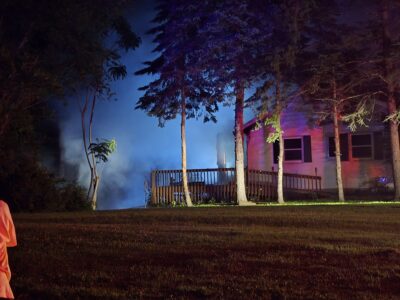
Flames damage Westfield home

Chautauqua Lake names April Students of Month
Tardive Dyskinesia webpage launched by Rural Minds
To raise awareness about tardive dyskinesia, the nonprofit Rural Minds has launched an educational webpage, ...
Civil Air Patrol volunteers at May events