
Trending
Blackjack is one of those games that seems simple at first. Cards have familiar values. 21 is the number to reach. Going beyond it ends the hand. Yet behind that straightforward idea sits several centuries of history. There's also a surprisingly deep mathematical side and a game that has adapted remarkably well whenever technology has changed.
It has moved from physical cards to early computer screens. It then made the portability leap to laptops and smartphones without losing its basic shape. Blackjack has picked up different variations and even a slightly mysterious name.
Here are some of the more interesting facts behind one of casino gaming’s best-known card games.
Blackjack Went Online Around 30 Years Ago
Online blackjack now feels completely normal. The idea would have sounded fairly futuristic only a few decades ago.
Online casino gaming started appearing during the mid-1990s. This meant blackjack was among the traditional table games that could suddenly be recreated through a computer screen. Those early versions were basic by modern standards. We only had simple graphics and far slower internet connections. The important idea had arrived: a blackjack table no longer needed to be physically in the same room.
The contrast is enormous now.
People can easily play online blackjack real money games be loaded through a browser on a phone or computer. This may even work without installing a separate app. Games can feature polished animation while live blackjack streams real dealers and physical cards directly to a player’s screen.
There are also far more variations available than those early online games could realistically offer. Classic blackjack sits alongside multi-hand versions and tables with different layouts.
The technology has changed dramatically. The central objective is still very familiar. To get closer to 21 than the dealer without going over.
Blackjack Is Much Older Than Its Name
The game itself existed long before people were calling it blackjack.
One of its clearest ancestors was a family of games known as Twenty-One (vingt-un and vingt-et-un in French-speaking areas). An even earlier Spanish reference appears in writing by Miguel de Cervantes from the early 1600s. He described a game called veintiuno in which the aim was to reach 21 without going beyond it.
That means the basic concept has survived for more than four centuries.
The game later spread through Europe and North America. It changed gradually along the way. The familiar blackjack name emerged much later...the end of the 19th century.
The Aim Is Not Actually Always to Reach 21
This is one of the most common misunderstandings about blackjack.
Twenty-one is certainly the best total available. Reaching it is not always required.
The real aim is to finish with a stronger total than the dealer without going beyond 21. A hand worth 18 can therefore be perfectly good if the dealer finishes with 17 or busts.
That distinction is important because blackjack is not a race towards 21 at any cost.
Sometimes taking another card would create more danger than opportunity. This is where much of the game’s strategy begins. A player may stand with a fairly modest total because the dealer’s visible card makes that the more sensible option.
The Ace Is the Game’s Most Flexible Card
Most cards in blackjack behave exactly as expected.
A seven is worth seven. Face cards are worth ten.
The ace is different because it can count as either one or eleven, depending on which value works better for the hand. That simple rule creates what are known as "soft" hands.
An ace and a six can initially count as 17. The ace can switch down to one if another card would otherwise take the total over 21.
This flexibility creates far more strategic possibilities than a fixed-value card would.
Blackjack Has a Mathematical Strategy
Blackjack repeatedly asks players to make choices.
Should the hand hit or stand?
Should a pair be split?
Is doubling sensible?
Those decisions led mathematicians and players to develop what became known as basic strategy. This is a system for choosing actions according to the player’s cards and the dealer’s visible card.
The idea became especially prominent during the 1950s and 1960s. Researchers used probability and early computing techniques to analyze enormous numbers of possible blackjack situations.
That mathematical side is part of what makes blackjack unusual.
Luck still decides which cards appear. Players are not completely passive once the hand begins. It gives blackjack a small puzzle inside every hand.
A "Blackjack" Is a Very Specific Hand
The word blackjack gets used as the name of the whole game. It also describes one particular starting hand.
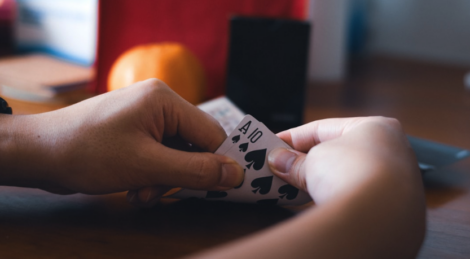
A natural blackjack consists of an ace together with any ten-value card. That could mean an ace and ten (or face card).
It matters that these arrive as the original two cards. Drawing three or more cards that eventually total 21 creates a 21-point hand, but technically it is not a blackjack.
This distinction comes from the game’s long development from earlier Twenty-One variants, where a natural 21 was already treated as an especially important combination.
There Are Far More Versions Than Many People Realize
Variation is the name of the game nowadays. Some games use one deck while others use several. There are versions built around playing multiple hands or different ways of handling certain card combinations.
Pontoon is another relative from the wider Twenty-One family. It is very familiar in Britain. Spanish 21 changes the deck and several parts of the basic format.
Online gaming has made these variations much easier to find because there is no physical need to dedicate an entire table to every slightly different version.
A digital lobby can offer dozens of blackjack tables side by side. More varieties for players in a rich online blackjack scene.