
The Mountainash
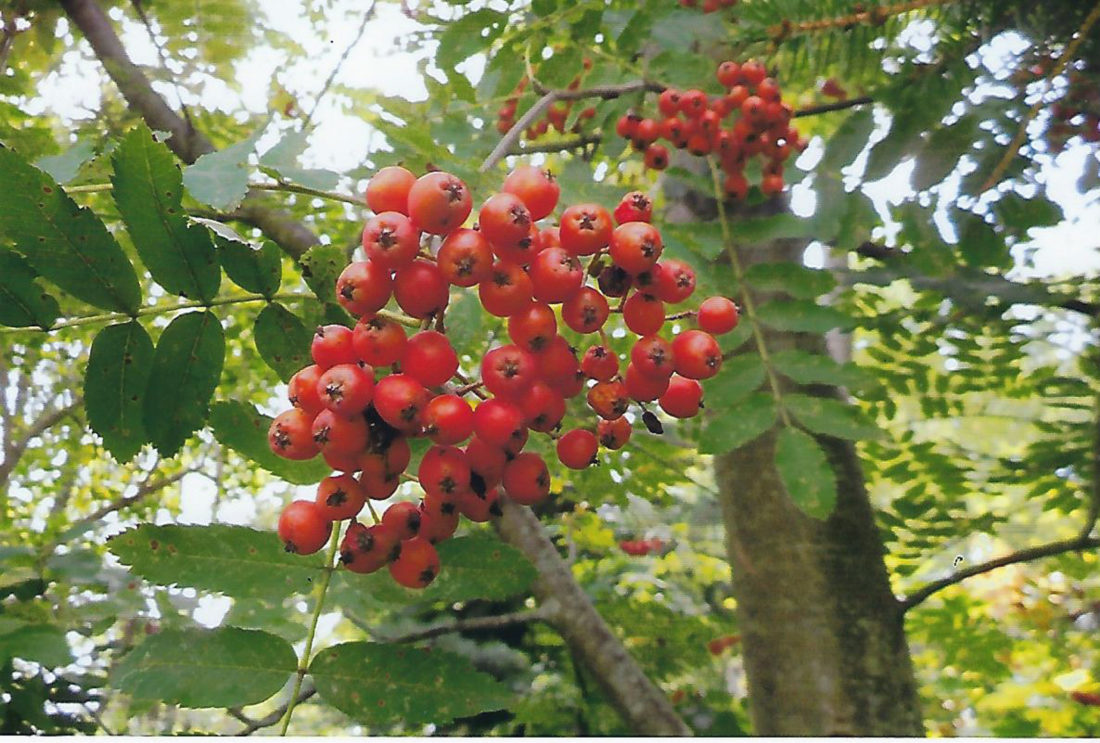
Photo by Susan Crossett
No, that isn’t a typo in the heading. The books prefer to list this tree under “M” instead of “A” though some may hyphenate the two words. I’ll stick with Mountain Ash which, honestly, doesn’t seem improper either.
I’m sure the decision to order Mountain Ash trees from the Chautauqua County SWCD was based on their description of the white blossoms, red berries and that it’s a favorite with birds and many animals.
My notes indicate these were purchased in the spring of 1999 and moved two years later to where they have since established dominance. A small tree, the books say. Maybe so but, standing beneath, they feel pretty tall to me. One tops out at thirty-seven feet. The other two measure close to thirty-three but that’s cheating in a way for they’re so heavy still with berries that these two bend over. What surprises me is how tiny the trunks are for such a tall tree. I measure just a foot for the two, a foot-and-a-half in circumference for the larger. Look at any other tree as you read this and you’ll see how thin that truly is.
The Arbor Day Foundation tells me my trees should have stopped growing when they reached thirty feet. Wikipedia will allow forty, which makes me glad. Another source says up to fifty feet tall. I’ll wait to see.
The Internet tells me this isn’t an ash at all but a member of the rose family. A native mountain ash is as beautiful, but tends to be more shrubby.
What I did see (while getting closer than I may ever have been before) was eye-level streaks of vertical holes. The woodpeckers have enjoyed their treats, too. Others must wait for the berries — enjoyed especially by grouse, robins and other thrushes, catbirds, waxwings, jays, squirrels “and rodents.” Add fishers, martens and white-tailed deer to the mix. Moose are said to prefer these too but probably not in my yard. Butterflies and bees are also attracted though I suspect they might prefer the blossoms to the later fruit. That fruit, incidentally, can stay on the trees all winter but, after the first couple of fall frosts, it may begin to ferment leading to intoxicated birds. (The holly bushes do the same.)
The bark is a pretty gray with uneven horizontal lines of yellow or white — or “marked with conspicuous, scattered, large pale lenticels” if you prefer. “How to Recognize Trees” which offered this description lists it under Mountain-Ash so I had to turn to the Ms in the index to find it. It can also be called the Rowantree, rowanberry, roundwood, mountain sumac, wine tree, dogberry, service tree, wild ash quickbean, life-of-man, Indian mozemize, missey-moosey and mose-misse. Really — those last ones? By whom? For what it’s worth the same tree guide says it rarely grows over a height of twenty feet with a trunk diameter of one foot or less.
As perplexing as these dimensions may be, I find myself equally perplexed by what actually is growing in my yard. Early notes say three were ordered. That numeral was replaced by a five sometime later. Then, over the years, it became a four and now three again. I have no explanation.
All my sources do agree that this is a delightful little ornamental tree whose wood has no commercial value. The berries, it’s said, are very acid and unpleasant to the taste. For people that is, birds would beg to differ.
WebMD calls the tree a plant and says the berries can be used to make medicine — fresh, dried, or cooked and then dried. They contain many chemicals, including vitamin C, and may be used to treat that deficiency. Other uses might be for kidney disease, diabetes, arthritis, swelling in the mouth or nose and “other parts of the body.” But “there isn’t enough information to know how it might work for the conditions for which people use it.” Surprisingly, it seems to be safely used as an ingredient in marmalade, stewed fruit, juices, liqueur, vinegar and some tea mixtures.
Whether written as American mountain-ash or mountainash, it seems there are up to fifty species of this tree. We associate it with the red-orange fruit but, it turns out, this is quite rare. White berries are much more common with others found in yellow, pink or “subtle in-between shades.” Ours is native to North America, particularly the Appalachians, New England and further north. Illinois has listed it as endangered which would be a loss. First cultivated in 1811, the bark was a favorite with pioneer doctors for treating malaria because it resembled the quinine tree.
The Internet can be a gift for my research led me to “Teen Wolf.” Its creator calls this tree “magic” but says he isn’t exactly clear how the tree exerts its power. Used primarily by druids it allows them to control werewolves and other supernatural creatures. It says one can create a protective barrier with just a circle or even a straight line. “Scott was also able to keep Gerard from turning into a werewolf by giving him mountain ash pills, so ingestion can prevent the Bite from taking hold. The victim will, however, bleed black blood continuously.”
Just so you know.
Susan Crossett has lived outside Cassadaga for more than 20 years. A lifetime of writing led to these columns as well as two novels. Her Reason for Being was published in 2008 with Love in Three Acts following in 2014. Both novels are now available at Lakewood’s Off the Beaten Path bookstore. Information on all the Musings, her books and the author may be found at Susancrossett.com.