
What Can I Do With My Pumpkin?
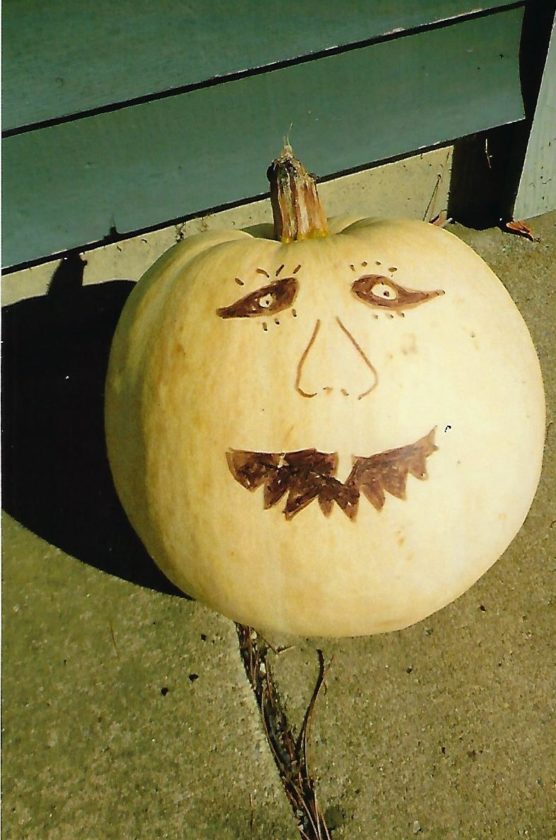
Photo by Susan Crossett
I was surprised at how many uses there are for a pumpkin. Read on.
Unlike some of the birds and many of the wildflowers, I don’t need to describe a pumpkin.
Oh, really? Well, all right then. Let’s start with defining a pumpkin as a cultivar which I now know means a variety of plant that has been produced only under cultivation. And a pumpkin is a cultivar which is round with a smooth (I beg to differ; OK, for feel but not for sight) skin that’s slightly grooved and deep yellow to orange in color. White pumpkins began to grow in popularity around twelve years ago. There are also some that are dark green.
The pumpkin is a form of squash and, like them, is believed to have originated in North America. (One does wonder how these things get started but pumpkin-related seeds that date to between 7000 and 5500 BC were discovered in Mexico so who’s to question?)
The words actually comes from one in Greek, “pepon” (my computer doesn’t write Greek), meaning a large melon, something round and big. The French changed the word to “pompon” which the British renamed “pumpion” which, crossing the Atlantic, became “pumpkin.”
Pumpkins are now grown all around the world except in Antarctica. While certainly popular in our fields here, the top pumpkin-growing states are Illinois, Indiana, Ohio, Pennsylvania and California. It is Illinois, however, that gets the prize, producing 95 percent of all those used for processing. Actually 85 percent of all processed pumpkin comes out of Libby’s plant in Morton, Illinois.
I found it intriguing that most commercial plantings count on honeybees for fertilization, one hive per acre says the U.S. Dept. of Ag. But if honeybees can’t do the job, the plants have to be pollinated by hand. (I picture all those folks dressed up in bee costumes sneaking out at dusk to do their work.)
I think most of us know that canned pumpkin puree and the filling sold for pies is mostly made from winter squash. Thinking beyond pies, it turns out that all of the plant (except the stem, I imagine) can be used in cooking: shell, seeds, leaves and even the flowers. I think it’s also OK to toss the yukky insides — but only after saving the seeds.
If you catch them young enough, when still green and tiny, pumpkins can be prepared just as we would any other squash or zucchini. (Do we really need more ways to cook zucchini?) Boiling, steaming and roasting comes to mind. Pureed pumpkin can also be safely frozen.
Pumpkin seeds are rich in protein, copper, zinc and magnesium and make a delicious snack. You can easily buy the seeds but why not roast them if you have an odd pumpkin lying around? The flowers can be used to decorate dishes and are delicious dredged in batter and fried in oil.
Other cultures enjoy the leaves. Chinese and Koreans cook them as a vegetable or add to soups. Myanmar candies them for a dessert while Thailand steams them filled with custard for their desserts. The Italians add cheese and stuff ravioli. Pumpkins can also be used to flavor alcoholic and non-alcoholic drinks. One can even press the seeds to get a robust oil.
It was Starbucks who, in 2003, introduced pumpkin spice latte. This led to a trend which certainly continues the popularity of pumpkin and spice flavored products.
More? Veterinarians may recommend canned pumpkin for dogs and cats suffering from constipation or diarrhea, even hairballs. Feeding raw pumpkin to chickens helps maintain egg production when it tends to drop off during the cold winter months. We shouldn’t be surprised to learn that Native Americans turn to pumpkin to treat intestinal worms and urinary problems.
And the jack-o’-lantern? The Irish and British have a long tradition of carving lanterns from vegetables. Only they used turnips, delighted when arriving in this country to find the native plant so much larger and readily available. Associated originally only with harvest time, it became an emblem of Halloween in the late 1860s.
Then there’s “chunking,” competitions using catapults and other mechanisms to see who can hurl a pumpkin the farthest. And of course the competition for the largest. Belgium won that in 2016 with one weighing 2,624.6 pounds.
Enough, don’t you think?
Susan Crossett has lived outside Cassadaga for more than 20 years. A lifetime of writing led to these columns as well as two novels. “Her Reason for Being” was published in 2008 with “Love in Three Acts” following in 2014. Both novels are now available at Lakewood’s Off the Beaten Path bookstore. Information on all the Musings, her books and the author may be found at Susancrossett.com.