
Woodward Awakenings
Trending
Springtime in the woodlands and wetlands of Western New York is a treasured time of rebirth, revelation, and resilience, advancing reliably even amid late season snows, dreary gray days, and cool wet weather. Spring's unfolding brings renewal and hope after the long months of winter's chilly darkness, and spiritual, emotional, and physical renewal for the winter-weary.
For plants, our region's vernal awakening is cued most reliably by the shortening of night length and hastened by rising temperatures and abundant rains. There is faithfulness in this springtime story, offering a reminder of the power of light and warmth and Earth's ancient certain spin around the Sun. As soils warm and showers come, microscopic bacteria, fungi, and other tiny creatures become active once more, working rapidly to decompose the remains of last year's autumn leaves and leftovers. Nutrients made available by these essential little recyclers, in turn, are soon absorbed by plant roots and incorporated into buds, blooms, and tender green bursts and bundles of new life.
Among the earliest of wetland flowers is the familiar skunk cabbage, whose emerging purply-green hooded flower clusters melt their way through frozen soils and snow and create a most welcome "warming hut" (up to 70 degrees F!) for early spring pollinators – tiny beetles, flies, and bees – along with spiders, ants, and other little creatures. Other early bloomers include the vibrant dandelion-like blossoms of coltsfoot and early blue, yellow, and white violets splashing color along sunnier trailsides and clearings. Other woodland flowers include early April's luminous white blossoms of bloodroot, enfolded in scallop-ruffled leaves, and the shimmery white, blues, violets, and pale pinks of tiny hepatica. More commonly encountered and aptly-named spring-beauties, pink-striped and petite, bloom in abundance in sunny clearings from mid-April on. Soon to follow in wet meadows and marshes are bright-yellow marsh-marigolds, or cowslips – one of the larger native members of the buttercup family. Speckle-leaved yellow trout lilies and purple, white, and painted trillium, wild ginger and goldthread, Solomon's seal and starflowers, May-apple and foamflower -- all reveal themselves in an unfolding pageantry of ephemeral and exquisite beauty and hue, each in its appointed time.
And time is short, for these earth-hugging forest wildflowers must mature and reproduce quickly before the trees fully leaf out and block the sun's life-sustaining and growth-fueling solar power. Bloom time must also be in synchrony with early-emerging pollinator-partners such as honeybees, bumblebees, beetles, syrphid flies, gnats, and thrips, crucial little go-betweens enticed by floral rewards such as nectar, pollen, oils, waxes, and warmth.
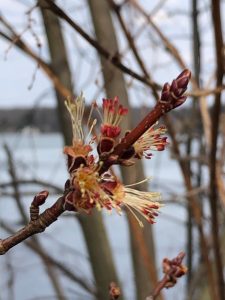
High overhead but often unnoticed, the trees of the forest are also abloom with fleeting spring blossoms. Maple, beech, birch, aspen, oak, willow, and many other trees are actually big, woody, wind-pollinated wildflowers! Bearing thousands of tiny, inconspicuous flowers in pastels of pinks, greens, creams, and yellows, many trees in our area produce massive amounts of dust-sized, life-giving pollen in late March, April, and early May. They, too, must set their pollen aloft before leaves unfurl and block the breeze, ensuring that pollination is unencumbered and efficient. For floral reproduction to be successful, both in the woody canopy and in the fragile spring ephemerals below, the pollen, which will deliver sperm, must find its way onto its particular species' sticky female flower parts, so that eggs may be fertilized and diminutive seed-borne embryonic plants may develop within the berries, nuts, samaras, capsules, and other fruits of the forest. Intricate in design and breathtakingly beautiful, whether high above or dwelling upon the good earth, each woodland bloom is fully functional, and holds a special hope and promise for us all… for if pollination and fertilization succeed, seed and fruit development will follow, ensuring new life in the forest for generations of spring-times to come!
The Chautauqua Watershed Conservancy is a not-for-profit organization with the mission to preserve and enhance the water quality, scenic beauty and ecological health of the lakes, streams, wetlands and watersheds of the Chautauqua region. For more information, visit chautauquawatershed.org and follow us on Facebook and Instagram.