
Secrets Of The Soil
Trending
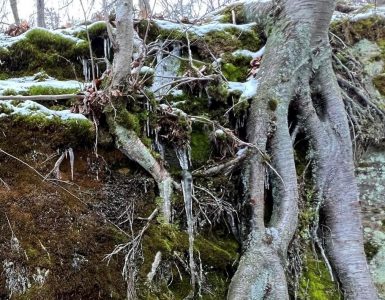
What lies beneath the snow and the surface? Soil has its secrets and is so much more than dirt and mud. Its precious medley of minerals, microbes, fungal mycelia, and nutrient-rich organic matter comes into being ever so slowly, often only an inch or so in depth over a span of 500-1000 years. It is marvelous, ancient stuff upon which nearly all life depends. But it is threatened.
Fundamentally, soil is an intricate mix woven together within a lacy fungal-plant root tapestry. It includes rock and mineral fragments - earthly stardust - subject to weathering and biological action; organic matter comprised of living creatures, their decaying remains, and wastes; gases; and water. In the fertile soils of our local forests, fields, and gardens, the upper layer is rich in dead and decaying leaves and other botanicals, countless creatures and their remnants, and extensive mycorrhizal fungal networks. A single teaspoonful of healthy garden soil teems with teeny organisms and may contain 5 billion bacteria, 20 million fungi, and myriad other life forms. The earthy fragrance of this damp, spongy layer is due largely to the microbial activity of actinomycete bacteria (which also create valuable antibiotics such as streptomycin and erythromycin), while vast carbon-storing, nutrient-mobilizing fungal filaments net it all together. Below this lies the crumbly, dark "humus proper," the end-product of decay and processing by the living realm, mixed and mingled with the mineral matter of weathered bedrock.
While decomposition of organic matter is dependent upon fungi and bacteria, soil animals aid the process in significant ways. A fallen leaf, softened by rain and dew, may be chewed by springtails, snow fleas, millipedes, and bristletails, leaving patterns and lines as the fleshy parts of the leaf are devoured. Fungi send tiny filaments into the mass to accelerate digestion and decay, while in turn, diminutive animals suck on the sugary fungal threads for nourishment. More nibbling and gnawing down to the veins by earthworms, roundworms, snails, slugs, wood lice, pillbugs, and beetle larvae follow, leaving the dismantled leaf in lacy filigree.
The process is incredibly slow - a single ash leaf may take a full year to decompose, while oak leaves and pine needles may require three years or more. In reality, thousands of years may be needed to create the productive soils upon which earth's biodiversity and all of us depend. Without wise conservation practices and proper safeguards, however, an exposed layer of centuries-old topsoil can wash away in one heavy rainstorm. Deforestation and poorly planned development including hillside construction, roadbuilding, and road-ditching without appropriate erosion controls, and other careless human practices, needlessly accelerate soil loss. Tragic consequences result, as this priceless stuff is swept from the land by wind and water and deposited downstream as suffocating sediments and fertilizing silt, fueling algal blooms and excessive plant growth in rivers and lakes below.
Farmers, gardeners, conservationists, and others close to the land have long understood the value of soil, and the gift of life it offers. In agriculture, the use of cover crops and no-till practices help minimize soil loss, while the conservation of valuable woodlands and wetlands, as long encouraged by the CWC, effectively protects soils and the complex communities they support. Restoration of streamside forests, grasslands, and other natural areas not only enhances water quality, fish and wildlife habitat, and recreational opportunities, but also sequesters significant amounts of carbon, so critical in the fight against climate change. Local municipalities and homeowners can be good soil stewards, too, through thoughtful land use planning, conserving vegetation whenever possible, using erosion control measures including sediment traps and silt fences around construction sites, and creating native plant buffers and rain gardens to capture soil-laden water and its precious cargo.
So, as you explore the frosty fields, forests, and waterways of our beautiful area this winter, and dream of your sleeping gardens under the snow, consider the complexities of soil and appreciate it as the ancient, life-giving, priceless mix of stuff that it is. Because the stuff of soil is the secret stuff of life, and it's a long time in the making.
The Chautauqua Watershed Conservancy is a not-for-profit organization with the mission to preserve and enhance the water quality, scenic beauty and ecological health of the lakes, streams, wetlands and watersheds of the Chautauqua region. For more information, visit chautauquawatershed.org and follow us on Facebook and Instagram.