
Our Hemlocks Are In Trouble!
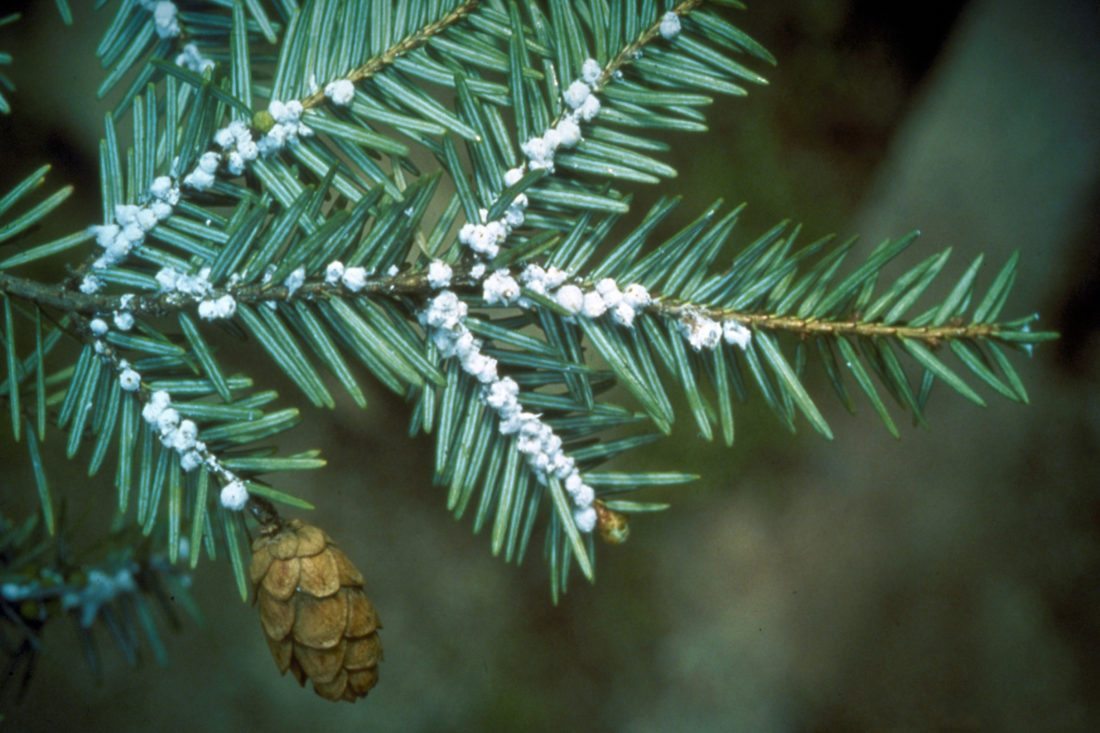
The presence of the hemlock woolly adelgid, an invasive insect, can be identified by its egg sacs, which resemble tiny white tufts of cotton attached to the underside of hemlock branches. Photo by the Connecticut Agricultural Experiment Station Archive via wikimedia.org
Eastern hemlocks (Tsuga canadensis) have been a staple of our forests in western New York for longer than humankind has been living here. As a long-lived tree species, they don’t reach maturity until at least 250 years of age and can live for over 800 years. They can grow well over 150 feet tall, and I have personally measured one in our area that was more than 12 feet in diameter. Hemlocks provide a wealth of ecosystem services. They form dense stands that make great habitat for many species, including songbirds, bats, and other mammals. Their ability to thrive on steep slopes in ravines and gorges makes them crucial to stabilizing these slopes and preventing erosion. Studies have shown that hemlock-shaded streams are more likely to support trout fisheries. Hemlocks are important to human economies as well. Historically, our ancient hemlock forests were logged for their bark as a source of tannins for the leather industry. Currently, hemlocks are important for the pulp and paper industries.
Despite their importance, our hemlocks are in trouble. They remain a very common tree species, but an introduced (invasive) insect called the hemlock woolly adelgid (Adelges tsugae) has threatened their continued existence in the eastern United States. The HWA was first discovered in Virginia in 1951 and is now established in 16 states spanning from Maine to Georgia. They are mostly spread by birds as they go from tree to tree, but they can also be spread by human activities such as timber transport and the tree nursery trade. The HWA is an aphid-like insect that feeds by boring a tiny hole in the needles of hemlock trees. Over several years, the tree will decline and die. This can take as little as 3 years if the tree is stressed, but some can survive 10 years if they are generally healthy otherwise. The extent of hemlock mortality has been most severe in Virginia, New Jersey, Pennsylvania, and Connecticut. Many areas in these states have seen quite extensive hemlock die-offs. This heavy loss of trees along steep hills and mountains has led to erosion and sedimentation of waterways. It has also promoted the expansion of other invasive species, as the canopy that was once crowded out is now open and the resulting additional sunlight allows invasive species like multifora rose and Eurasian honeysuckle to thrive. Long-term impacts will only be determined over time, but a large-scale change in the makeup of forest species will surely reverberate through the food web.
The situation isn’t hopeless, however. Many improvements have been made in the timber and nursery trades to limit the unintentional spread of HWA. There are a variety of pesticide-based protections that can help, although they are more suited to protect individual trees than an entire forest ecosystem. Some current research indicates that treating just 10% of a forest a year can have a positive impact, and the chemical treatments can be effective for several years. According to many sources, biological control would be most effective. Biological control means using a natural predator, parasite, or disease to manage a problematic creature like HWA. The goal is to find a species that will naturally control HWA populations without negatively impacting other facets of the local ecosystem. This can be exceedingly difficult, as one runs the risk of introducing an organism that may be more harmful than what you are seeking to eliminate. Currently, there are three insects being studied as potential biocontrols for HWA, Laricobius nigrinus (a beetle), Leucopis argenticolli, and L. piniperda (two species of silverfly). There has been some success with the beetle, but the research is hampered by an inadequate method of propagating the beetles in a laboratory setting.
There is plenty for all of us to do to help! In order to monitor HWA infestation, regular field surveys need to be conducted. CWC has over 1,000 acres of nature preserves in Chautauqua County, and it is our responsibility as stewards of these lands to ensure they are kept as ecologically healthy as possible. In the winter months, we team up with the Roger Tory Peterson Institute of Natural History and Jamestown Community College to survey our properties as well as other unique habitats and state forests in the region. These surveys mean hiking or snowshoeing out to a hemlock stand sometime between January and March (when HWA are most likely to be seen on the branches of a hemlock tree) to search for signs of infestation. We have been lucky and haven’t found any new infestations in recent years, but HWA has been documented in Fredonia as well as in the Zoar Valley region. If you are interested in helping with these upcoming surveys, you can attend a free survey training at RTPI on Wednesday, November 1st from 6 to 7 p.m. Contact the CWC or RTPI for more information.
The Chautauqua Watershed Conservancy is a local not-for-profit organization that is dedicated to preserving and enhancing the water quality, scenic beauty and ecological health of the lakes, streams, wetlands and watersheds of the Chautauqua region. For more information, call 664-2166 or visit chautauquawatershed.org or facebook.com/chautauquawatershed.
Nature
Bryophyta And No Rolling Stone
Staying Warm During A Cold Winter

What To Know About When We Get So Much Snow
The Secret World Beneath The Snow
There Is Life Beneath The Snow
Winter Exposes Troubled Trees, Bark
The seasons are changing from fall to winter, and one of the major changes to the environment is that the deciduous ...