
Slumbering Until Springtime
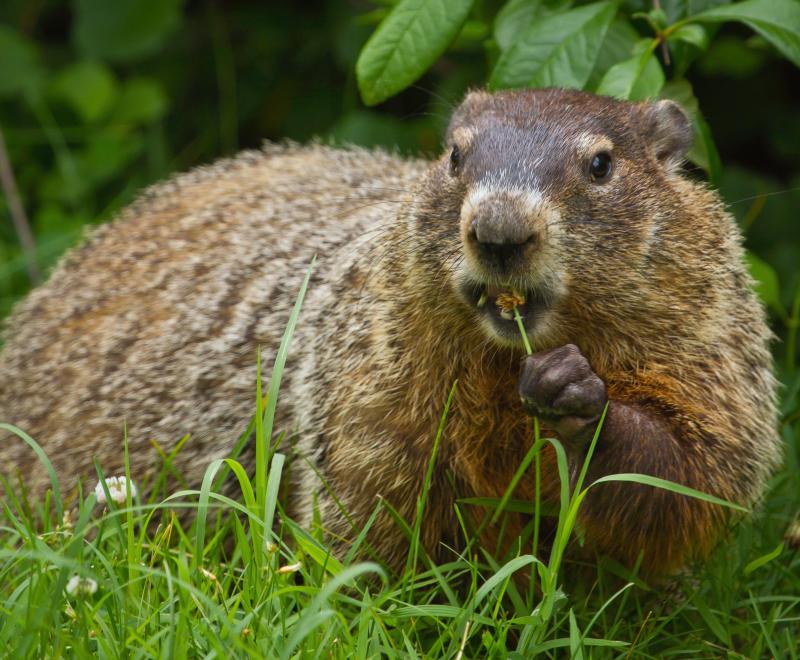
Woodchucks begin entering deep hibernation in late September or October, after gorging on clover, grasses, and other vegetation all summer long and laying on a thick layer of fat to sustain them through winter. Photo courtesy National Park Service, nps.gov
For many weeks now, the squirrels have been scampering about through my backyard trees, chasing each other in wild courtship dances and scurrying in and out of my bird feeders. Chipmunks have been chattering and chipping and stuffing cheek pouches. A yearling woodchuck (aka groundhog) cautiously explores the greening garden, enjoying the warmth of the springtime sun and finding welcome nourishment each morning in the spilled corn and sunflower seeds left behind by the birds. Night-time visitors come too, long absent during the cold dark days of winter – opossum, raccoon, skunks, and deer mice – all in search of apples, seeds, and other goodies to fuel the frenzied activities of spring.
But where was everyone all winter, when food was scarce, nights were long, and temperatures were bitterly cold? How did these creatures manage to survive during that long and challenging snowy season?
You might think that hibernation is the answer, and for certain animals like the chipmunk and our little woodchuck, that’s very true. Woodchucks begin entering deep hibernation in late September or October, after gorging on clover, grasses, and other vegetation all summer long and laying on a thick layer of fat to sustain themselves through winter. Deep within a hibernation chamber up to five feet underground, a very plump, solitary woodchuck curls up in a grassy nest and enters into the profoundly altered state of metabolism known as “deep torpor.” Body temperature falls from near 97∂F to less than 40∂F, and the heartbeat slows from 80 beats per minute to only four or five. Breathing becomes almost imperceptible, slowing to only one breath every six minutes, and oxygen consumption plummets dramatically. Rigid and decidedly cold to the touch, a deeply-hibernating animal can not be easily awakened. Although brief periods of arousal may occur if the body temperature drops dangerously close to freezing or for other poorly-understood reasons, the woodchuck’s time of deep sleeping may extend until mid-February – over a period of nearly five months! Spring arousal and warming of the body requires both violent shivering by involuntary muscle contraction and the “burning” of brown fat, which releases large amounts of heat. In spite of extensive research, the underlying cellular mechanisms of hibernation are poorly understood, and much mystery remains concerning the incredible physiological changes so critical to the survival of our little groundhog.
And what about my other springtime visitors? The tiny deer mice use daytime torpor and huddling in communal nests to stay warm and conserve energy in winter, but they become active (but unseen) most nights through grassy tunnels under the insulating blanket of snow. Similarly, female striped skunks may be found huddled together to stay warm, nesting communally with other females or with a single male within a burrow or other protected place, sleeping much of the winter away.
Skunks, raccoons, and possums are not true hibernators, but instead might best be described as “long winter nappers.” Nappers cannot dramatically reduce their body temperatures, as most true hibernators can, but they do den up for many days at a time to conserve energy and sleep through the harshest of winter periods. Slumbering in tree cavities, leaf nests, hollow logs, or abandoned woodchuck burrows, most nappers awaken periodically to forage for food, especially during mild periods. Some, such as the red and gray squirrels, retrieve readily-accessible hoards of pine and maple seeds, beechnuts, acorns, fungi, and berries, strategically hidden in trees or even buried under the snow. Once filled and satisfied, back to bed they go.
And finally, what about bears? Bears are unique hibernators, with some of the most extraordinary survival strategies of all. By late summer and early autumn, black bears have eaten large amounts of nuts, berries, flowers, ant brood, and other foods in order to accumulate the five-inch layer of fat to sustain them during the winter. By October, they stop eating, and seek out an appropriate den within a hollowed tree or other sheltered spot. Once denned for the winter, black bears become lethargic and enter a state of prolonged sleep in which heart rates may decrease from 80 beats per minute to less than 10. Breathing slows dramatically. Unlike other hibernators, the bear’s body temperature remains normal, and arousal may be rapid if sufficiently disturbed. The metabolic marvel, however, is that the bear does not eat, drink, urinate, or defecate for five months or more, while burning up to 4,000 calories a day! Surviving on the thickness of its fat layer alone, the bear’s unique metabolism is able to generate heat and safely recycle nitrogen (an otherwise potentially dangerous metabolic waste product) into protein, which in turn maintains the bear’s muscle tissues in spite of inactivity all winter long. And because the bear does not urinate, it stays hydrated without needing to drink. By early February, one or two newborn cubs may be nursing and nestling into mama bear’s fur, all sleeping together peacefully until springtime comes again in the Chautauqua watershed.
Becky Nystrom is a Professor of Biology at Jamestown Community College, a long-time CWC supporter and volunteer and a founding trustee of the CWC. The Chautauqua Watershed Conservancy is a local not-for-profit organization that is dedicated to preserving and enhancing the water quality, scenic beauty and ecological health of the lakes, streams, wetlands and watersheds of the Chautauqua region. For more information, call 664-2166 or visit www.chautauquawatershed.org or www.facebook.com/chautauquawatershed.
Nature
Bryophyta And No Rolling Stone
Staying Warm During A Cold Winter

What To Know About When We Get So Much Snow
The Secret World Beneath The Snow
There Is Life Beneath The Snow
Winter Exposes Troubled Trees, Bark
The seasons are changing from fall to winter, and one of the major changes to the environment is that the deciduous ...