
Breaking Down A Stream Stabilization Project
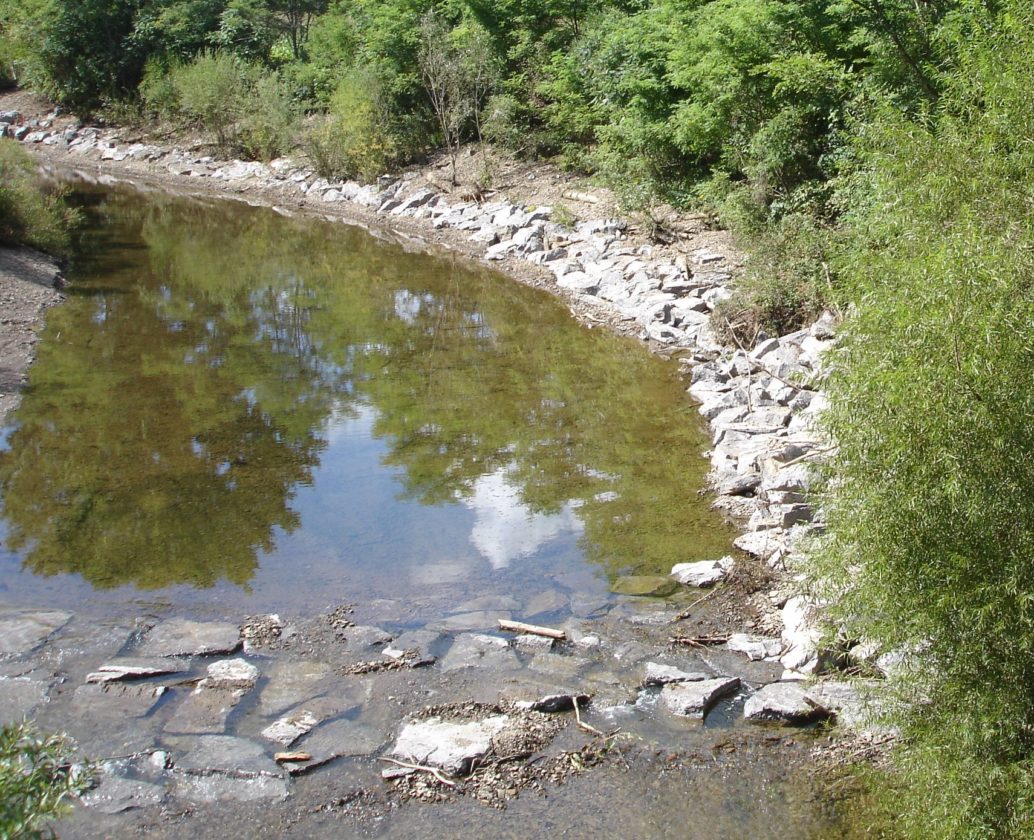
“Rock riffle is a section of stream where the water is very shallow and rocks break the surface, which benefits fish habitat because oxygen is mixed into the water as it flows over the rocks. Photo by Randall Perry
“Stream stabilization” definitely isn’t part of everyone’s vocabulary, but here at the Chautauqua Watershed Conservancy, we talk about it on a daily basis. Water Quality Improvement Projects, which are meant to reduce erosion in the Chautauqua Lake Watershed, are the main reason for our obsession. In my last Watershed Notes article, I wrote about how Water Quality Improvement Projects are funded and the benefits of reducing erosion.
In case you didn’t read my last article, the purpose of the New York State Department of Environmental Conservation’s (NYSDEC) Water Quality Improvement Project (WQIP) Program is to reduce polluted runoff, improve water quality, and restore habitat. The WQIP Program uses New York State Environmental Protection Funds to accomplish these projects. In 2015, Water Quality Improvement Project grant awards were secured by the Chautauqua Lake and Watershed Alliance and Chautauqua County, which also incorporated local matching funds from the County’s Occupancy Tax Program. As a result of these local dollars committed by the County, New York state awarded about $1.1 million to accomplish several projects throughout the Chautauqua Lake watershed. These projects are a team effort which includes landowners, the agencies listed above, the Chautauqua County Soil & Water Conservation District and the Chautauqua Watershed Conservancy.
The 2015 grant award will be spent stabilizing parts of six streams. Projects have already been completed on Prendergast and Bemus Creeks, with more work on Bemus, Ball, Goose, Dutch Hollow, and West Dutch Hollow Creeks to proceed in the future. Certain sections of these streams were chosen for stabilization due to the rapid erosion occurring there and the magnitude of benefits that may be achieved from reducing it.
Stream stabilization frequently involves cutting back the stream banks where possible. In lieu of providing a real floodplain, cutting back the banks lets the water spread out and slow down. Did you ever cover the end of a hose with your thumb to spray a friend with a faster stream of water? Cutting back the banks is like removing your thumb from the hose and allowing water to come out more slowly. Slower water means less capacity to carry sediment and less force to cut into stream banks and cause erosion.
Stone toe protection is frequently installed during stream stabilization projects. This involves using powerful construction vehicles to move large limestone blocks – some the size of Volkswagon Beetles – into lines that protect the lower portion (or toe) of the bank. In some cases, multiple layers of limestone blocks are stacked on top of each other. In streams that really rage after rainstorms, these limestone blocks may be pinned to underlying shale bedrock to ensure they don’t get swept away. Stone toe protection is meant to provide a barrier between and eroding stream bank and the force of the stream’s current.
In Prendergast Creek, a rock riffle was built into the stream bed. A riffle is a section of a stream where the water is very shallow and rocks break the surface. Riffles benefit fish habitat because oxygen is mixed into the water as it flows over the rocks. Many aquatic macroinvertebrates (insects with no backbones that live in water) live in riffles because of this oxygen abundance. Some fish eat these insects, so riffles provide them with food.
After stabilization, the banks of a stream are quickly hydro-seeded and planted with willows. These seeds and willows are meant to put down roots quickly and hold exposed soil in place so that it’s not swept away in the first rain storm. If possible, its best to plant native species to cover the banks. At the stream stabilization project on Ball Creek, which will take place on CWC’s Ball Creek Preserve, there are plans to plant numerous native species to re-forest the stream corridor following construction.
These carefully engineered features of Water Quality Improvement Projects protect wildlife habitat and reduce the loading of sediment into local lakes and streams. While terms like ‘stone toe protection’ and ‘rock riffle’ may not be part of everyone’s vocabulary, they are elements of stream stabilization that benefit all of us.
The Chautauqua Watershed Conservancy is a local not-for-profit organization that is dedicated to preserving and enhancing the water quality, scenic beauty and ecological health of the lakes, streams, wetlands and watersheds of the Chautauqua region. For more information, call 664-2166 or visit www.chautauquawatershed.org or www.facebook.com/chautauquawatershed.
Nature
Bryophyta And No Rolling Stone
Staying Warm During A Cold Winter

What To Know About When We Get So Much Snow

The Secret World Beneath The Snow
There Is Life Beneath The Snow
Winter Exposes Troubled Trees, Bark
The seasons are changing from fall to winter, and one of the major changes to the environment is that the deciduous ...