
Trending
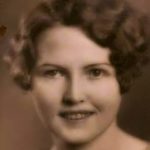
My great aunt Gladys is a legend in our family, for the things we know and for those we don't. She was a flapper, a beauty, the favorite of the family. Our great-grandfather Alfred called her "baby" as she was the youngest of the Johnson clan. She died at age 30 in 1933; within a year, both of Gladys' parents were dead too. It seems her premature death killed them though by then our great grandmother Ida, was all twisted up with arthritis and spent her days on a settee downstairs at their home on upper Barrett Avenue. Alfred was still vital, well off despite the crash of 29. He owned half a dozen properties on the South Side of Jamestown, most of which he had built himself, most of them on Newland or Barrett avenues. His neighbors and his loved ones called him the King of Barrett Avenue for a number of reasons. But one thing is for sure, when glamorous Gladys died, Alfred's heart and health broke.
My father, Raymond was only 12 when Gladys died, so how well could he have known his aunt? She lived next door, just across the yard, and had a room upstairs. We know this because both dad and his sister Helen note that Alfred once or many times locked Gladys in her room upstairs but she climbed out to go and meet her "Italian boyfriend" down in Brooklyn Square. My father and his sister Helen both say this with eyebrows raised a little but a smile of understanding in their eyes. They both admired her, that was clear. Gladys did what she pleased. She was exceptional.
More than that, Gladys exemplified a flapper -- this bold new young woman of the 20's who dared to be different, to be independent, to be glamorous and maybe a little wild. To break traditions. To flaunt rules. She, like the women of my own generation, saw more to their future than traditional roles.
I'll tell you what my father told me of the glamorous Gladys. I've heard that the way someone speaks our name denotes how they feel about us. When my father said Gladys, it was hushed and prayerful. "I loved those three sisters of mine, each one different and yet the same, and I loved my three aunts too -- Bertha, Dolla and Gladys. But Gladys, Gladys was something. She was a dream, all that flaming red hair, all that perfume. She went out with her girlfriends on weekends and sometimes her sister Dolla too, down to the music halls in Brooklyn Square, sometimes to Buffalo and Cleveland. They walked down Forest Avenue arm and arm, laughing and whispering together. What a sight they must have been, those tall and elegant Johnson girls in their chic flapper clothes, their cloches, their fancy shoes tap tap tapping.
My father recalls Gladys' room as full of scent and smoke. She would let him come inside and sit on a chair while she listened to music on the radio or got ready to go out with friends. Her father had bought her a Tiffany lamp in New York City. The lamp swirled with light from the multicolored birds painted on the glass; it cast the room in various hues of blue and gold. A cigarette was always burning in an ashtray on her dressing table. My father said, "the smoke and colors hypnotized me. I was just a boy. She seemed like a movie star to me."
"Who do we want to hear right now?" she would ask when one song was over on the radio and before another began. Gladys said this in a way that emphasized some immediacy of time. Maybe she had an inkling of her own fate. I don't know. She liked Billie Holliday, Ethel Waters, Cab Calloway and his Cotton Club Band. The songs, the voices, the music always sounded like pounding rain, smoke and molasses, sorrow -- my father said. He was too young to understand such feelings yet. Gladys loved Gershwin's Rhapsody in Blue best of all, and when it played, she would sit absolutely still on her dressing table stool, brush in hand. Her head leaned back, her chin jutted out, just so, and moved to the music. Her red hair gleamed in the light. The piano notes spoke to her. They rose and fell and moved between moods. Gladys was lost in the music at those times. My father never forgot the sight of her in that moment. He whispered when he spoke of her. That song made his heart ache in some strange way. It was prescience, perhaps.
On a glorious October day just shy of her 31st birthday, the beautiful Gladys walked down to a doctor's appointment. It would be her last appointment. Gladys walked down there and back again. Later that night, she took to her bed. In those days, nobody went off to the ER. The doctor was called. He came and went. He said she had an infection. In those days, if you were ill, you just stayed in bed and prayed to get better.
She never left that bed except to be carried downstairs in Alfred's arms for a wake in the parlor. My aunts Helen and Marian told me they heard great grandfather Alfred weeping from next door, through the walls of the house, through the windows, in the air of the side yard -- my baby, my baby, my baby. The King of Barrett Avenue wept for his lost daughter. They remember standing in a row inside the darkened room. The minister came--the one who had confirmed her in the Lutheran Church when she was 14. Relatives swept in from New England, from Illinois, from Iowa to pay their respects. Letters of condolence arrived from Sweden. My grandfather Ben kept them, archivist, keeper of secrets. The house, afterwards, fell silent. Doors closed. Window shades were drawn.
Ida Johnson, Gladys' mother, died soon thereafter, and Alfred within a year. It was the end of the reign of Alfred. After that, my grandfather, the kindly Ben, took over as the family head, a role he held until he died in 1966.
This is the part of the story we hear in hushed tones. For 30 years after Gladys died, someone brought flowers to her grave, someone married, some distinguished Latin man whose name everyone knew, the man her father had tried to stop her from seeing. But that's how it is, isn't it? Especially when we are young and ruthless. We love whom we love; the heart makes its own choices. Sometimes love is a matter of life and death, especially for women.
So all we have of our Great Aunt Gladys Johnson is this narrative. She lies with her brothers and her parents in the first row of the southwest corner of the Lake View Cemetery, ever an enigma and a memory, a rhapsody in blue.