
Hometown History: Tools Of The Trade
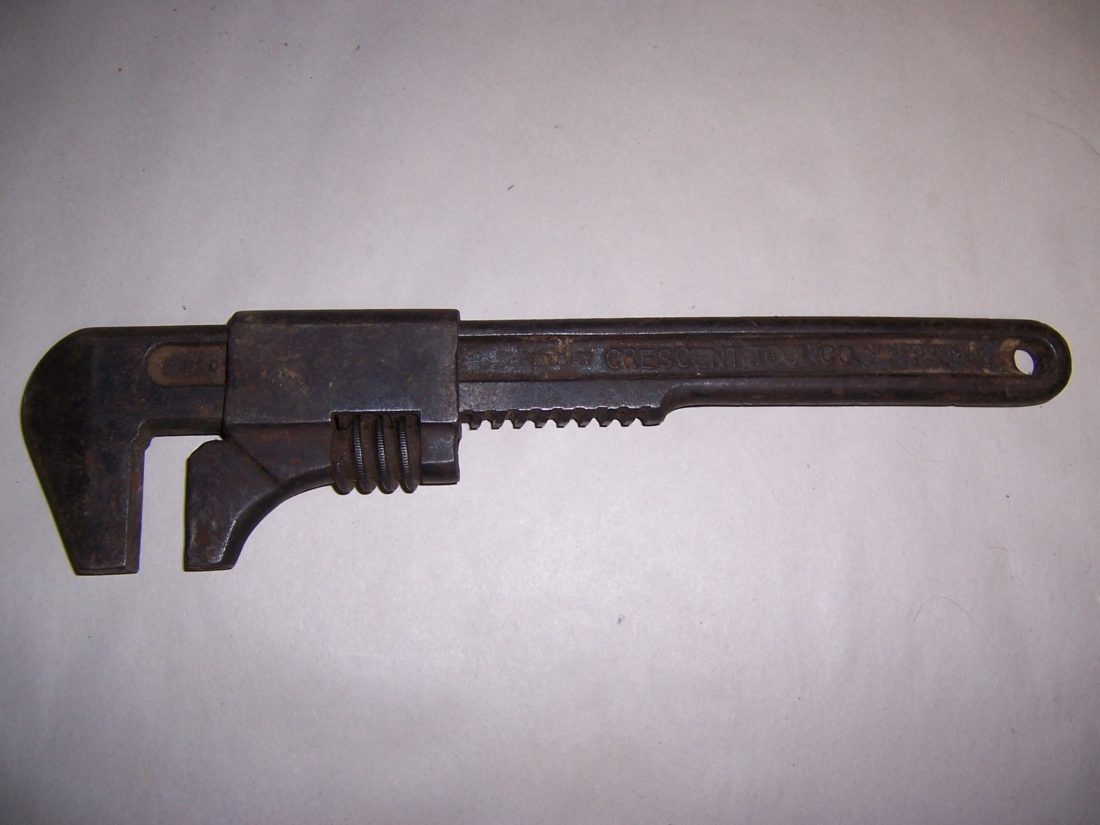
An early example of a Crescent Tool pipe wrench. Tools like this have had a surprisingly large impact on history.
Today’s item is a Crescent Tool pipe wrench, a thoroughly mundane tool and one still made elsewhere and sold today. This particular example is an old one and it represents an old Jamestown business.
This wrench came to us via Edwin Holmes, who went into the plumbing business in the early 1920s, first with Olson Plumbing and later on his own. Holmes Plumbing and Heating is listed in the city directories up through the 1958-59 edition.
Pipe wrenches, although they have been a subject of interest for countless inventors, haven’t changed a great deal in a century. The pipe wrench came into use when iron and steel pipes came into use, replacing wood and lead, and they still are useful with copper and plastic.
The history of civilization could be written from the perspective of plumbing — and maybe has been. An abundant water supply, along with both water and sewage treatment facilities are necessary for sustaining any large, concentrated population. Residents of the first cities in ancient Sumer and Egypt had to go down to the river and get their water. But for cities much larger than Jamestown to become practical, some artificial provision had to be made for a water supply. The Roman penchant for building aqueducts was one reason they were able to maintain and organize such large populations.
Sewage was another matter altogether. There were a few civilizations that were relatively more attentive to waste disposal, the Mayans, the Romans again, and the Minoans and Indus Valley civilizations back in the Bronze Age. For the most part, though, disposal was extremely crude and careless even in the cities of colonial America.
Early Jamestown was small enough so each person and family at least had a back yard but it wasn’t until approximately the 1840s that rural school districts even built outhouses for the convenience of the children.
Local pioneers relied on springs for water. Throughout the 19th century rural people dug wells for their water supply. These were usually from 6-10 feet wide and less than 20 feet deep. Water was dipped or hoisted up in a bucket. For personal waste, early settlers just went out in the woods and later built unheated, uninsulated outhouses which of course had no water supply and no provisions for washing.
Starting in the 1870s, the first piped water supply in Jamestown was intended for fire protection. A decade later, it was redone for household use. Water was drawn from wells and from the lake, filtered, then distrusted under pressure. It then became possible for residents to install water flush toilets, first as a luxury, but eventually as a necessity. Half unnoticed, this created a radically increased demand for water.
It was April 11, 1893, that work began on the sewers in Jamestown. At first there was no treatment of any kind, just an open pipe into the Chadakoin. It was only after an epidemic and a lawsuit in the 1920s that chlorination of the sewage was instituted. Chlorination of the water supply on a regular basis wasn’t begun until the 1940s–1950 for Lakewood.
Chautauqua County used to be peppered with thriving tiny villages. Many factors conspired to bring about their demise, but outstanding among them was the requirement, now amplified by state and federal laws and regulations, for extensive, expensive waste collection and treatment systems. The fate of these small hamlets impressed this on me over a few years’ time. Driving through their downtowns, I have seen the buildings abandoned one by one. Some are bulldozed, only to be replaced by open parks. These towns will likely never come back because the typical small assemblage of little retail businesses or Mom and Pop manufacturing firms are unable to support the infrastructure cost of the necessary water and sewer systems. What sufficed in the 19th century, be it ever so unpleasant to contemplate, required only a few dollars and effectively no water at all.
Anyone who really studies history sees how nearly everything, big things and small, are tied together. Some events can be reversed, but many, because of the tie-ins, cannot except by catastrophic collapse accompanied by major population decreases. But until and unless – the simple pipe wrench will remain one of the essential objects of civilization.