
‘World’s Greatest’ Spoke At Chautauqua In 2008
Trending
EDITOR'S NOTE: The following article appeared in the June 24, 2008 edition of The Post-Journal, the day after sports writer Frank Deford gave a lecture at Chautauqua Institution. Described by GQ as "the world's greatest sports writer," Deford passed away Sunday. He was 78.
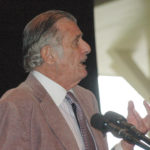
CHAUTAUQUA -- Even though the well-wishers were growing by the minute, creating a line that was snaking its way from behind the Chautauqua Institution bookstore and spilling onto the sidewalk at Bestor Plaza, Frank Deford appeared in no hurry Monday afternoon.
Fresh off his morning lecture, which kicked off the summer of speakers and Week One's theme, "Sport in America," Deford was engaged, smiling, autographing his books and shaking hands.
"How tall are you, 6-10?" one man asked.
"No, I'm only 6-4," Deford replied.
But one could understand the confusion. After all, Deford, a man GQ has called, simply, "the world's greatest sports writer," is indeed a giant in his field.
The large crowd at the Amphitheater found that out during a late-morning talk that centered on the hype and hypocrisy of sports, with plenty of humor thrown in for good measure.
"Many of you may be familiar with a basketball coach best known for his antics in Indiana, now bivouacked somewhere in West Texas -- Bobby Knight," Deford said. "Bobby once said the best time in any sports writer's life was the three years he spent in second grade."
Then Deford, 69, paused.
"Thank you very much for letting me come in and lower the standards."
The line was met with laughter, but Deford, an author, commentator and senior contributing writer at Sports Illustrated, has been the standard-bearer in an industry he first got a taste of in the early 1960s.
Fresh out of Princeton University, Deford went to work for SI. His first assignment was to write a story on the Los Angeles Lakers of the National Basketball Association.
"I was supposed to meet the team in the hotel lobby to fly off to the next city," Deford recalled. "I think I put both Brylcreem and Vitalis on my hair, put on my new checkered sport jacket and put on a pair of horn-rimmed glasses to make myself look a little bit older. I came downstairs hoping that no one would notice me."
Elgin Baylor, who would later became one of the NBA's 50 greatest players, did. Unfortunately.
"He was Michael Jordan before there was a Michael Jordan," Deford said. "He was also the team leader and the funniest guy on the team. He looked over at me and in a loud voice said, 'I didn't think Ralston Purina was making sports jackets.'
"That was my welcome to the big leagues."
Since those red-faced beginnings, Deford has, among other things, been elected to the Hall of Fame of the National Association of Sportscasters and Sportswriters, voted by his peers as the U.S. Sportswriter of the Year six times and twice been voted Magazine Writer of the Year by the Washington Journalism Review. He's also a commentator every Wednesday on National Public Radio's "Morning Edition" and, on television, he is a regular correspondent on HBO's RealSports with Bryant Gumbel.
All those opportunities and accolades have come about because Deford has been able to tell a good story.
"The best sports to write about," he said "are those where the competitors are the fewest and they're wearing the skimpiest clothes."
So even though he has an apparent disdain for soccer -- "I'm sick and tired of the rest of the world calling us Americans dumb because we don't like soccer like everybody else" -- he's also quick to point out that it was that game that made him fully understand the power of sport.
The year was 1990 and Deford, on business in Europe, was asked by his editor to write a column on the World Cup. Deciding it was a good idea, he visited Cameroon, a country in Western Africa, which was playing England in the quarterfinals.
"It was an impoverished country," Deford explained. "I don't think anything good has ever happened there, (but) this was their chance to beat mighty England and, if they did, they could have won the whole World Cup."
So Deford found a local bar filled with soccer fans, who were hoping to witness history.
"That's where I was when Cameroon scored the first goal of the game," he said. "A short, fat lady standing next to me grabbed me and started dancing with me."
A photograph was taken of the unlikely pair and it is, Deford said, the "only sports photograph I keep in my office."
Unfortunately for his dance partner, Cameroon lost.
"I've never felt so much despair around me in my life," Deford said. "You think about how much Boston cares for its Red Sox, Chicago and its Cubs, and Green Bay and its Packers, but this had never happened to those people in that country on that day.
"Our teams lose and, sure, we're upset, but, hey, life goes on and it's a good life. We're so very blessed. I think the people in Cameroon knew that they weren't going to have another chance like this. I never understood the power of sport until that moment."
So even though Deford doesn't mind taking issue with the likes of the International Olympic Committee ("the Olympics are the festival of sports that nobody cares about for the other three years and 50 weeks."); and big-time college sports ("amateurism is like Communism. It might look good on paper, but it simply doesn't work in the real world. It's always been a problem."), he embraces the notion that for "all its abuses and all its excesses, sports can still be embraced by us all."