
Trending
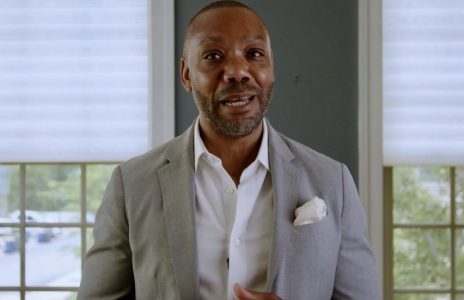
Andre M. Perry on Friday joined the CHQ Assembly as part of the African American Heritage House Lecture series.
Perry is a senior fellow with the Brookings Metropolitan Policy Program, a scholar-in-residence at American University and a columnist for the Hechinger Report. He discussed his work in race and structural inequality, education, economic inclusion and his new book, "Know Your Price: Valuing Black Lives and Property in America's Black Cities," during his lecture.
Perry said he started his work by analyzing his hometown, Wilkinsburg, Pa., a small, Black majority municipality near Pittsburgh. He showed slides of his home and his mother, Elsie, who adopted him through his maternal grandmother.
"You see, my mother, Karen, was poor -- she already had a child at 15 and had me when she was 17," Perry said. "She was probably abused. So, Mom did what a lot of matriarchs did at the time: She informally adopted me. She took in not just me and my brother, but about a dozen or more other kids throughout my lifespan."
Perry said he stayed with his adopted mother, Elsie, through high school because his father was addicted to heroin. He said his father was in and out of prison and was later killed in prison. Due to the circumstances in which he grew up, Perry set out to "study their life by looking at the physical conditions around them."
"Almost immediately, I found that they both lived in areas that were redlined, where the Homeowners Loan Corporation drew real lines around Black neighborhoods, deeming them too risky for investment," Perry said. "They were also displaced by highway projects led by the Federal Highway Administration that put highways literally on top of Black neighborhoods."
Other issues such as urban renewal projects and racial housing covenants made it so his parents couldn't leave that area. Even if they wanted to buy homes, predatory lending practices did not allow them to do so fairly. However, this was not just the reality for Perry's parents -- it was a reality for many in America.
"I wanted to look at that past history and its impact on today's current environment," he said. "What we found is what most people will assume -- that homes in white areas, in general, are priced higher than in Black neighborhoods. In fact, as the concentration of Blackness in a neighborhood increases, the prices decrease. It's pretty linear."
Perry said they used information from Zillow and national Census data that clearly embodied this trend. While many would say the lower values found in Black neighborhoods are due to education and crime, Perry said this is not the case. In fact, he said the study had controls for education, walkability and other metrics built-in.
"And what we found pretty much astounds: That homes in Black neighborhoods are underpriced by 23%, about $40,000 per home," Perry said. "Cumulatively, that's about $156 billion in losses."
Perry said he often gets the question of how he differs from his father.
"I say to them, 'There is no difference,'" he said. "There are many Black people who are snatched up by racism. This is why I always say there's nothing wrong with Black people that ending racism can't solve. When something goes wrong in Black communities, we blame the people. We don't look at the policy conditions that erode the quality of life of those people, and that extracts wealth, opportunity, equity and money. Clearly, I'm doing well. But my father should have been right here speaking to you today."
Perry said this impacts Black communities, not only in the housing market but also in economics. Many people start businesses with equity in their homes -- but if there is no equity in the home, no businesses can be created.
"Now case in point, Black people represent about 14% of the population, but only 2% of the nation's employer firms, meaning firms with more than one employee," Perry said. "Now, a lot of people will say the reason you don't see as many Black businesses is because of quality of service because folks don't know how to manage their businesses."
That premise is not true, he said. After compiling data from Yelp regarding Black, Hispanic and Asian businesses scored higher than other businesses in this area. However, he discovered that these businesses received less revenue in more African American populated areas.
"As a result, folks aren't patronizing those businesses in Black neighborhoods," Perry said. "And high-quality businesses are losing out on upwards of $4 billion. There's a saying in the hood that my elders and others used to utter, and it's something that spoke to me in this study. They would say, 'Our ice is just as cold.' The elders knew that if you don't frequent quality businesses in the hood, you distort the market in ways in which high-quality businesses are forced to compete against low-quality businesses."
In turn, Perry said less revenue, less economic development, and less community action are funneled into these neighborhoods. This perpetuates the cycle and leaves these neighborhoods trapped and undervalued.
"It emphasized that Black assets are devalued," Perry said. "There are policy actions that ignore or deflate the potential and the opportunities of assets in Black neighborhoods."
These issues can be changed, Perry said; however, real changes will have to be put in place.
"If people deny racism … they are burying their head in the sand to the very problems that are throttling Black growth and throttling the economy," he said. "If again, Black people represent about 14% of the population but only 2% of employers. If the percentage of employer firms matched the Black population, we would see 800,000 more firms in the United States. Trillions of dollars of revenue, greater GDP, more employment, more increases in salaries. We are cutting off noses to spite our faces every day when we don't invest in Black assets."
Perry said when underappreciated assets are invested in, it helps the economy and society as a whole. These policies would be beneficial for everyone.
"Nothing grows without investment," he said. "Thich Nhat Hanh, the Vietnamese philosopher, once said that if you see a head of lettuce and it's not growing, you don't blame the head of lettuce. You look to see if the soil is rich, you look to see if it's getting rainwater, and you look to see if it's getting sunlight. You don't blame the lettuce. When things go wrong in Black neighborhoods, we blame the lettuce. We have got to end that."